
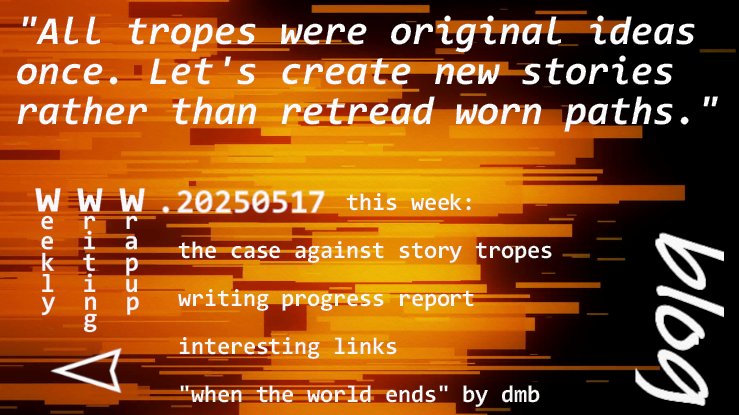
This week: the case against story tropes; an update on my writing; The Spike-related links; and “When The World Ends” by DMB.
limited
Tropes in book publishing and marketing are not new, but have recently become supercharged. What are they, why have they become so prevalent, and is there another way?
Trope (noun): something such as an idea, phrase, or image that is often used in a particular artist’s work, in a particular type of art, in the media, etc.
Examples of common tropes in films are:
- The Chosen One – e.g. Harry Potter, Neo.
- The Reluctant Hero – e.g. John Wick, Bruce Banner.
- The Mentor/Apprentice Relationship – e.g. Mr Miyagi and the Karate Kid, Yoda and every Jedi.
In the world of novels, they’ve long been used by publishers to determine what’s popular and what to focus on. If they know fantasy books with an orphaned protagonist are selling well, for example, they’ll focus on publishing more of them.
It seems a lot of readers like using tropes to select which books to read, the main advantage being you know what you’re going to get. The genres that have historically been used to categorise novels are wide and vague, whereas tropes are more specific. There are so many books being published, and people have less spare time than ever to waste on something they don’t like. Tropes are a way of mitigating the risk. Some readers stick to a very limited range of tropes, perhaps liking the familiarity, perhaps treating them almost like comfort food.
As consumers have become more media-savvy and the use of tropes has become more generally known, publishers have realised this is a marketing opportunity. Now, if you search on social media for “books”, you will be greeted by a string of cover images surrounded by their tropes, usually with curly arrows.
This is the easiest, dare I say laziest, form of promotion. There’s no creativity or imagination, nothing to inspire or excite, just a list of categories.
I considered including a collage of examples here, but it didn’t seem fair to single anyone out. Many indie authors may be following the trend as it’s something they can do relatively easily and cheaply, and I don’t begrudge them that.
So publishers love tropes, and many readers like them. But I don’t.
As a reader, I like to be surprised. I want to read things I’ve never read before. I don’t want to spend my limited free time on a book that fits neatly into a series of boxes that have proven popular.
I find it boring to read the same thing over and over; it’s why I always make a conscious leap to a different genre after I’ve finished a novel. I try to know as little as possible about a book when I first pick it up – I have a long list of books I want to read, and usually by the time I get around to reading one, I’ll have forgotten why I added it in the first place.
If a book does incorporate tropes, I certainly wouldn’t want to know what they are when I start reading. Some, like enemies-to-lovers, are massive and obvious spoilers.
As a writer, I try hard to create the surprise and originality I would want to read. I’ve never intentionally incorporated a trope, although may have unintentionally. I won’t rule out using one in future either, but if it were to be intentional, it would be to subvert it in some way.
This does make selling my books more difficult.
It’s part of the reason I decided to self-publish. I realised a publisher would be unlikely to take a risk on my work without heavy changes that I did not want to make.
I’ve heard of authors who’ve had rejections from publishers, not because their book wasn’t well-written or an enjoyable read, but because they didn’t know how to sell it, as it didn’t include established tropes. Whilst I understand publishers are in business to make money, I find it sad that novels they admit are very strong don’t have a place in their catalogue. It makes you wonder what wonders we could be missing out on.
This state of the marketplace can motivate authors to write to what they think publishers want rather than what interests or inspires them. This lack of passion can be obvious in the finished product, and the only people it will make happy are the money-men. I personally couldn’t maintain the motivation to write something I didn’t believe in.
I would rather write an interesting book I can’t sell than a derivative book I can sell.
I hope the current fad with tropes will fade, or face a backlash from defiant writers who won’t be confined in their story ideas. All tropes were original ideas once. Let’s create new stories rather than retread worn paths.
progress_report
Work continues on the series bible for The Spike. The going has been slower than I would like: it’s heavy going recording all the information that could be relevant in future, and the early chapters are naturally more dense with data, such as character and location descriptions.
I’m currently up to chapter 4 of 81 and need to pick the pace up.
status.vol2
The Spike Volume 2 will contain three separate books from the perspective of seven characters.
Draft 2 is complete!
I’ll go through my revision plan in a future blog.
The ultimate aim is to have Volume 2 finished by the end of 2025 for publication early 2026.
connecting_links
The Spike is set in our world, incorporating real events; the links below are relevant to the themes and overarching storyline, and may or may not provide clues to the direction of the series.
I do not necessarily agree with or endorse any of the views within.
You think ransomware is bad now? Wait until it infects CPUs
Wealthy Britons avoiding more tax than previously thought, spending watchdog says
Sci-fi author Neal Stephenson wants AIs fighting AIs so those most fit to live with us survive
Republicans Try to Cram Ban on AI Regulation Into Budget Reconciliation Bill
White House fires Copyright Office leaders as controversial AI report surfaces
AWS says Britain needs more nuclear power to feed AI datacenter surge
weekly_inspiration
Every week I share something that’s inspired my creativity.
This week, I’ve been listening to the Dave Matthews Band track “When The World Ends”. If you’re even dimly aware of world news, I’m sure no explanation is required as to why this particular song struck a chord, so to speak.
The Dave Matthews Band aren’t well-known in the UK, but are big in the States. This live performance of the track is from their Central Park Concert in 2003, with an audience of more than 120,000 people.
What’s inspired you this week? Please share in the comments.
See you next week.
 Arrowmaker Books