
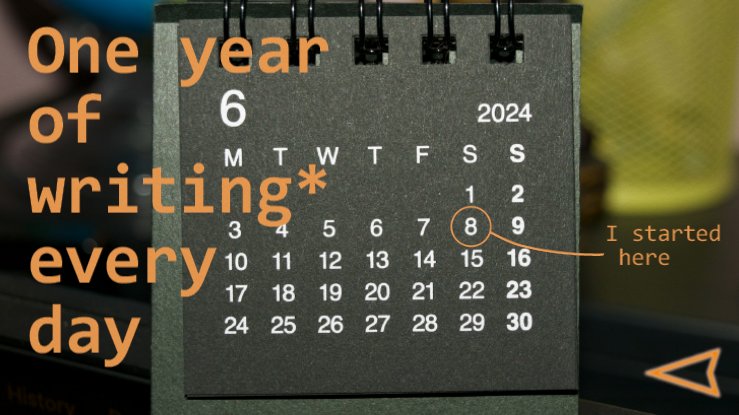
Blog season 2, episode 1: consistency.
I don’t want to boast, but I’m a level 99 procrastinator. It’s not just the horrible or boring stuff I dawdle over, I’ll even put off things I was looking forward to, which I’m fully aware is bizarre behaviour.
And yet, publication of this piece marks my 367th consecutive day working on my writing as an author of thrillers, technothrillers, and (self-evidently) a blog.
That’s whilst I work a full-time job and run a household solo.
What’s surprised me is that it’s been easier to keep up with than I anticipated since I magpied ideas from other creatives.
I’m not going to claim my process will magically work for you. It probably won’t, because there’s a very strong probability you aren’t as weird as I am.
You need to tailor a routine to your own constraints and, more importantly, your personality.
I’ll share how I’ve done it below; please magpie anything that might work for you.
First, let’s get my rules straight. You may justifiably be wondering why there’s an asterisk against “writing” in the title. That’s because, technically, whilst I didn’t put words down on the page every day, there were other writing-adjacent tasks I did instead which contribute to the end goal, such as:
- Brainstorming
- Outlining
- Research
- Editing
- Creating a series bible
- Readthroughs
- Cover design
- Website maintenance/redesign
- Blogging
I don’t count social media use as a writing-adjacent task, even though I’m only active on my author accounts; if/when I get more structured with my posts, I may count it then.
In case you think this is cheating, let me explain why including these tasks is important.
Firstly, all these other parts of the process are fundamental to my publication and promotion of a novel. You may remove or add some for your own situation, but there will always be necessary tasks that don’t add directly to the word count.
Secondly, every writer has days where they forget every word they ever knew and sit in front of a blank page, grunting. Ok, perhaps the grunting is just me, but sometimes words won’t word.
There are other tasks that need doing, such as researching London street names or how to murder someone without leaving a trace, or designing a cover, or making a self-publication plan, so I use the time I was going to spend writing on one of these instead. That way, I’m still progressing the overall project.
Thirdly, every person has days where they feel unwell, or other commitments get in the way. As a procrastinator, if I know I only have thirty minutes until something else needs doing, that’s an excuse not to start, because Heaven forbid I need to stop when I’m in the middle of writing a chapter.
There’s never not been a day when I can’t spare ten minutes to research something, even if it’s just before I go to bed. Once I’ve done it, in spite of it being a struggle or an inconvenience, it gives me a boost, a sense of achievement.
Again, as long as I’m still contributing to the overall project, I can mark it down as progress.
Maintaining momentum is the main tenet of my routine.
My memory may have conflated a couple of sources, but Jerry Seinfeld wrote (or still writes) a joke every day, and I believe he had a calendar on the wall that he would tick off when he’d written a joke. It’s a very visible method of holding oneself to account.
I took that idea and put my own spin on it. I use spreadsheets all the time for my day job, so I created one that would keep track of my writing progress. One of the sheets is a calendar, and it will very simply highlight each day whether I have written (green) or not (red).
Around the same time, I saw someone on YouTube (apologies to whomever it was, I can’t remember you) suggest gamifying tasks. The thing I took from this was the idea of continuing a sequence of success; it can be almost addictive. I got on a long Wordle streak and, even though I didn’t enjoy it anymore and it had become a chore, I wouldn’t stop because I wanted to see how far I could go.
I added a formula to the spreadsheet that would show me how many consecutive days I’d written for. The first time I got past seven days, I didn’t want to stop. I haven’t stopped.
I didn’t go straight from doing very little to doing a lot, though. I gradually wrote more regularly, not beating myself up if I missed a day early on. The two weeks before I began the year-long streak were:
2 days off
1 day on
1 day off
3 days on
2 days off
5 days on
1 day off
367 days (and counting) on
Whenever I’ve wanted to make a change to my routine, I’ve always done it steadily. I know that if I try to ramp up too quickly, and am not successful, it can knock me back.
Every increase I’ve made has been incremental.
If I make a change that’s too much of a struggle to maintain, I return immediately to the previous level I was comfortable at. For example, during November last year, I took part in NaNOWriMo and averaged 1,770 words per day. By the end of the month, I felt burnt out, so I returned to my prior level. It might have been tempting to stop completely for a rest, but restarting would have been more difficult.
Writing is much like fitness. If you haven’t exercised for a while, when you restart, you get tired quickly. As you exercise more regularly, it becomes easier, and you can exercise for longer. If you stop for a period, like over the holidays, you won’t be at the same level as when you stopped, and will need to rebuild to where you were before you can continue to improve.
It’s easy to argue that missing one day wouldn’t make much difference.
I know that if I did this, I would subconsciously be lowering the importance of my writing in my mind, which opens the door to making excuses the next time I don’t feel like it. Probably the very next day. And thus I have willingly stepped onto the clichéd slippery slope.
I also know I’d be losing the built-up benefits of working on a project regularly.
When I keep a project fresh in my mind, my subconscious will work on it even when I’m doing other things, and will find solutions or come up with new ideas that may otherwise have eluded me.
Moments of inspiration are increasingly likely to strike the more often I work on my project.
As a perfectionist as well as a procrastinator, I’m always looking for ways to improve my process.
My next aim is to increase my number of individual writing sessions per week, from the current average of eleven, up to fourteen (averaging two per day). Not a massive increase, but it should be possible and make a noticeable difference to my output. If it’s successful and I think I can do more, I will increase the target again; if it causes a problem, I’ll return to my prior solid base.
Resilience is helpful, of course, but the biggest reason I haven’t faltered is that I’m honest with myself. I know when I’m making excuses, I know when I can’t be bothered, and I know I’ll be happier at the end of the evening if I’ve spent my time productively instead of watching another YouTuber get confused reacting to The Matrix.
I’m tough on myself, but I’m not an evil bastard.
I won’t set a minimum time limit or word count. I work until my focus wanes. Sometimes that’s ten minutes; sometimes it’s two hours. If I feel I haven’t done as much as I would have liked to for the day, I’ll go away and do something else and maybe try again.
And herein lies my last nugget:
Forcing it will turn it into a chore. Keep it fun.
If this is of any help to you, please let me know, either in the comments or on social media.
What’s the longest writing streak you’ve completed?
What tricks or routines do you use to maintain consistency?
What’s one thing you wanted to do but still put off?
Thanks for reading.
Featured image background photo by Chandan Chaurasia on Unsplash
 Arrowmaker Books