
I doubt any prologue in the history of gaming has garnered as much attention as that of Clair Obscur: Expedition 33, and with good reason. It’s a masterclass, connecting you with the characters, the story, and the world so effectively that many a tear has been shed within the first hour.
There’s been an understandable focus on the harbour scene and the Gommage (if you know, you know), but the very first scene sets the tone perfectly and tells us a great deal without it feeling like an info dump.
Here, I’m going to break it down, shot by shot, line by line, to decode how it’s so brilliant.
Spoilers ahead for the prologue and act 1 of Clair Obscur: Expedition 33.
Please don’t read ahead until you’ve played it; it’s an experience you don’t want to miss.
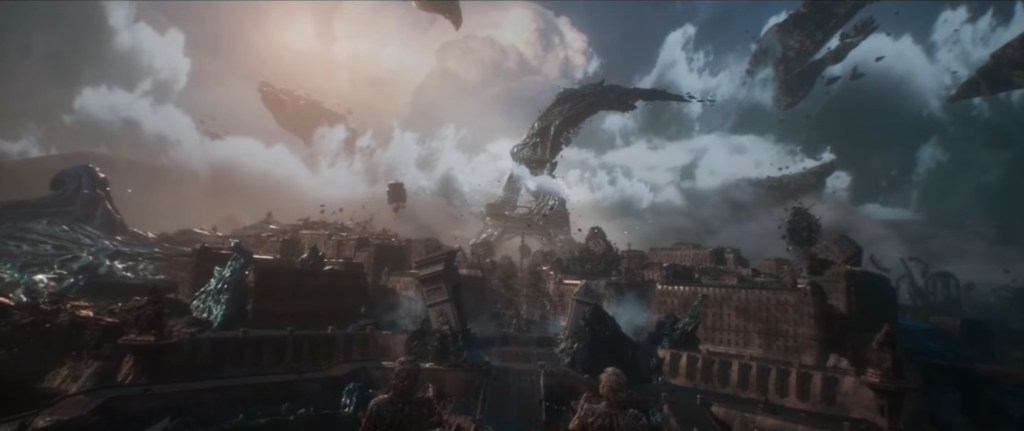
After starting a new game, the very first shot establishes the where of this game. The Eiffel Tower tells us we’re in France, but it’s warped and fractured. Great slices of rock float in the sky. Something is very wrong with this world we’re entering.
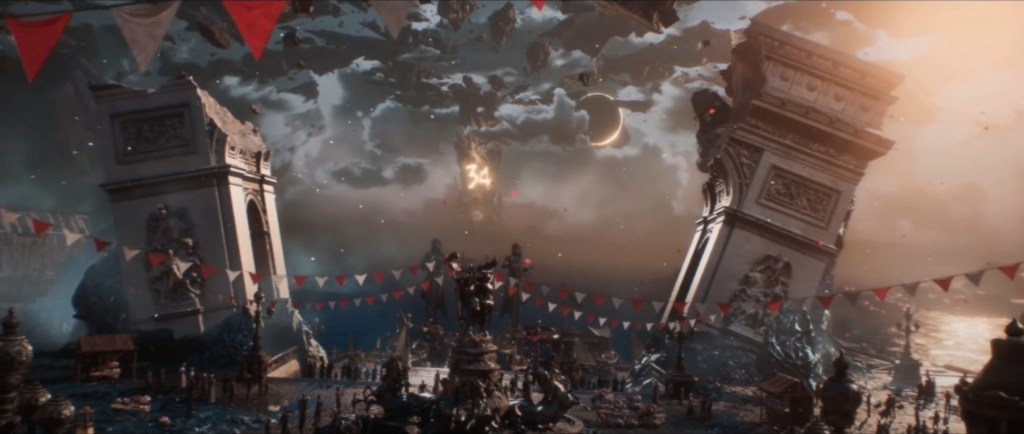
Next, we see the Champs-Élysées, solidifying that we’re in France, but it’s split in two and leaning apart. It draws our gaze to the centre, and a structure in the distance with a glowing “34”. This is supposed to be “Expedition 33“, that’s weird, isn’t it? And, despite the broken state of the city, red and white bunting hangs around the harbour. What could they be celebrating?
There’s not much to define the time period (bearing in mind this is a fantasy world), but the lack of modern architecture might signify pre-1950?
Already, it’s creating mystery. We have questions.
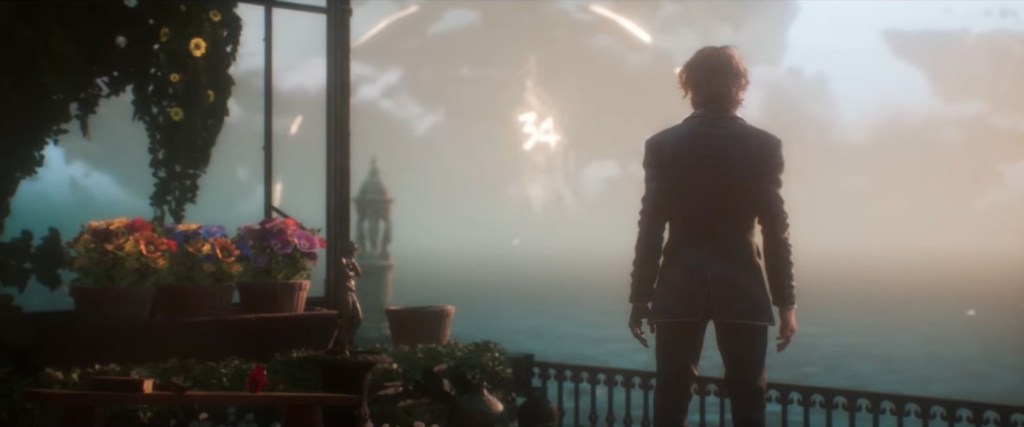
Variations on the next shot are repeated through much of the game: a character staring out at the structure with the number glowing like a beacon. These last two shots together emphasise the importance of this structure.
And this first person we’re seeing, is he the main character? He appears deep in thought, perhaps apprehensive. Again, that his focus is on the structure demonstrates it’s at the centre of this world.
We get an artful shot of this character framed by swaying branches, refocussing our attention on him. He’s looking around, but doesn’t appear to be doing anything much. Putting off something he doesn’t want to do?
His formal dress added to the lack of anything else modern suggests we’re in maybe the early 1900s, or at least a place that hasn’t evolved past that aesthetic.
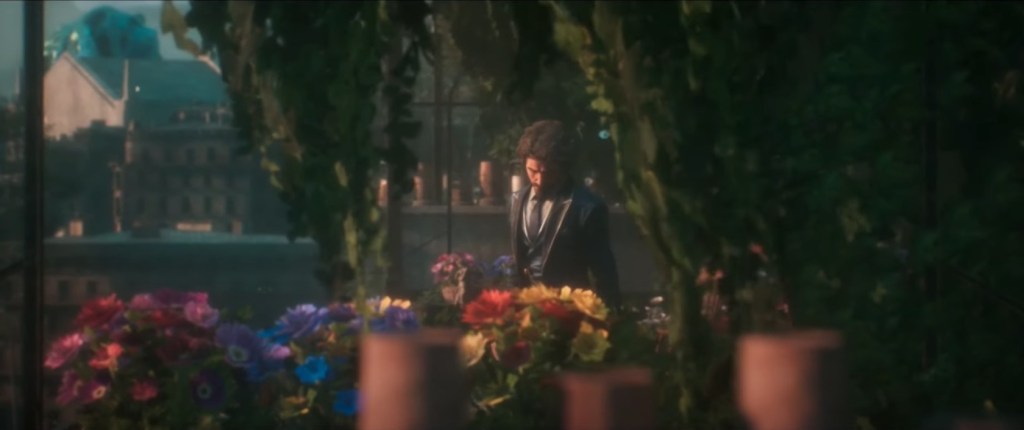
Then, we zoom out and see we’re on a rooftop terrace. He’s surrounded by flowers and petals, something that will soon take on extra significance during the Gommage. It looks like an idyllic space in a world we’ve already seen is broken. A final moment of peace before Hell breaks loose?
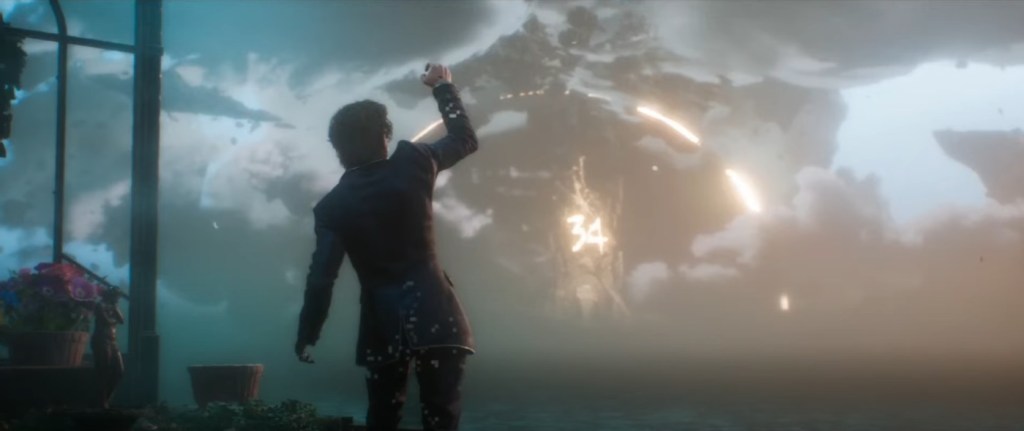
He leans down and picks up something. A rock.

He throws the rock at the distant structure, literally showing us that this is his target, his objective — soon to be our objective. We don’t yet know why, but it’s fair to assume from the previous shots that this is related in some way to the fracture of this world.
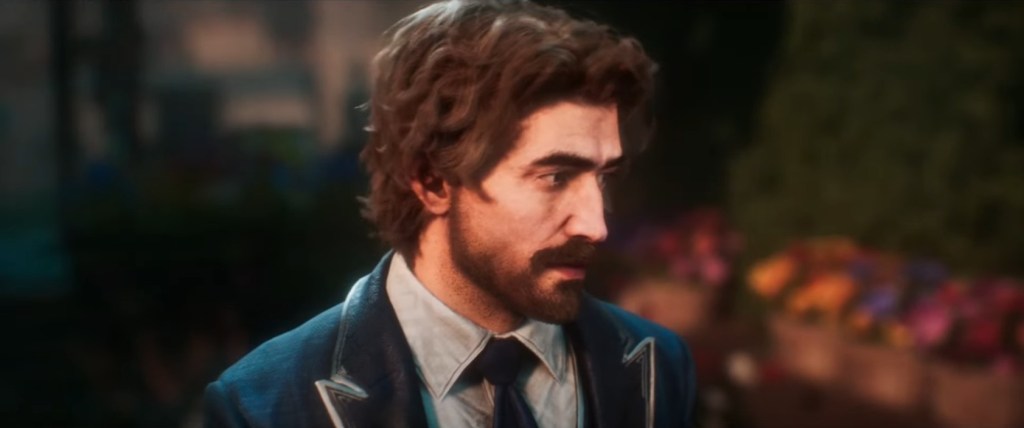
We get our first close up of our main character, clearly with a weight on his mind. What’s troubling him?
The camera pans across to a lone red rose sat on a bench, linking it to the main character’s troubles. The recipient of a single red rose is usually a love interest, but his hesitancy suggests they’re having difficulty or aren’t together at all.

This is when we hear the first lines of dialogue:
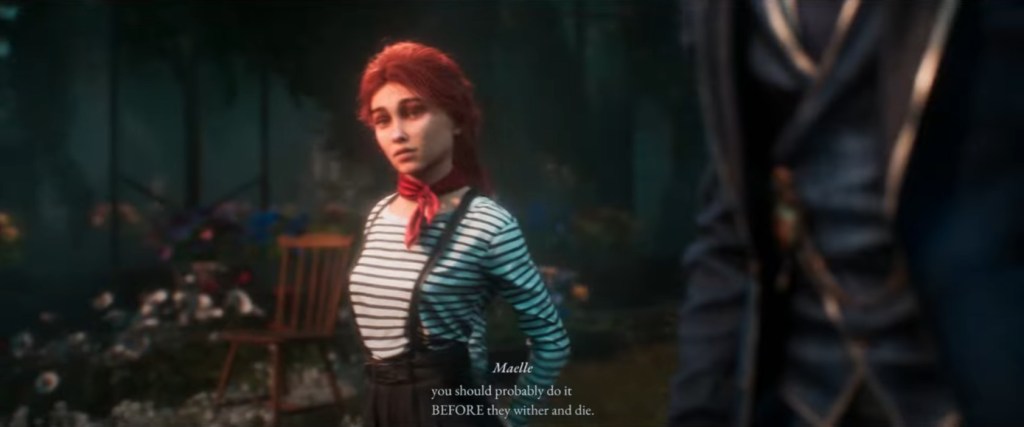
MAELLE
If you’re gonna give someone flowers, you should probably do it BEFORE they wither and die.
GUSTAVE
What? The flower? Or Sophie?
MAELLE
Ooh, dark. Sophie would approve.
Just three lines, but they tell us so much. Firstly, from the subtitles, we find out the names of these two characters: Gustave and Maelle.
Next, we now know the flower is for someone called Sophie. From Gustave’s reluctance, we know there’s history, probably painful, between them; from his reply, we can infer that Sophie is soon to die. Is she sick? From Maelle’s response, Sophie has a dark sense of humour, and is likely prepared for what’s to come.
That Maelle’s comfortable enough speaking to Gustave this way, without any kind of hello, shows us they’re close. The teasing, the reference to Sophie, and the age gap (too large for them to be a couple, too small for them to be father/daughter), hints at a brother/sister dynamic.
So far, there’s been beauty, but the tone has been foreboding. The injection of humour with the game’s first words reassures us this won’t all be heavy going.
The quickest method to build connection with a character is to demonstrate as soon as possible that they have some of the classic positive personality traits that almost everyone finds attractive, and this scene has already used four of them.
First, appearance: Gustave is a handsome and smartly-dressed chap.
Second, humour: we feel closer to someone we can laugh with.
Third, love: Gustave is pining for Sophie, and we’re naturally more drawn to people who care.
Fourth, friendship: someone who’s created a strong bond with another person feels safer to share our feelings with.
Gustave drops to a crouch and looks at Maelle.
MAELLE
Hey, you said it, not me.
The others are waiting for you, you’re supposed to be helping with the festival.
GUSTAVE
With what? Putting up three tables? They’ll manage.
MAELLE
Ah. You underestimate Lumière’s enthusiasm for the Expedition.
There’s at least FIVE tables.
GUSTAVE
Marvellous.
Here we learn that the bunting is for a festival celebrating the Expedition. Gustave’s involved, but is disheartened; expecting only three tables, either the Expedition is small, people’s interest in it is minimal, or both.
Maelle is slightly more positive, and tries to lift his spirits.
In addition, we find out where we are: Lumière. This is also the name of the song that’s playing at the start of this scene; it’s wistful and a little playful, and fits the tone perfectly. As our focus shifts more to the characters, however, the score switches seamlessly to Gustave’s theme, which is used sparingly through the game to great dramatic effect.
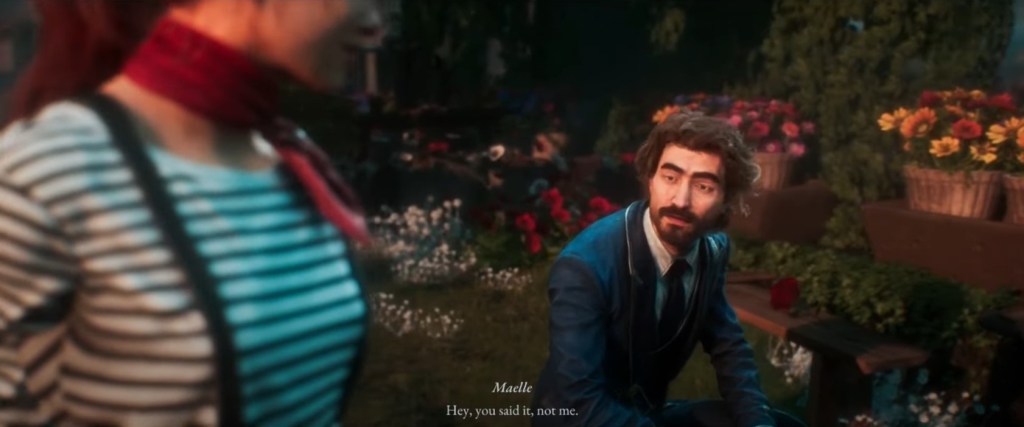
Gustave picks up another rock, stands, and throws this one at the structure in the distance too.
MAELLE
Have you tried throwing with your other arm instead?
If you could hit the Paintress directly that would actually be useful.
More information disguised as banter. Exposition is necessary in every fantasy story; the trick this scene pulls off is to provide it so entertainingly that it feels fun.
Our attention is drawn to Gustave’s left arm, a mechanical prosthetic that will be his main weapon in the battles ahead.
More importantly, we now have a name for our enemy: the Paintress.
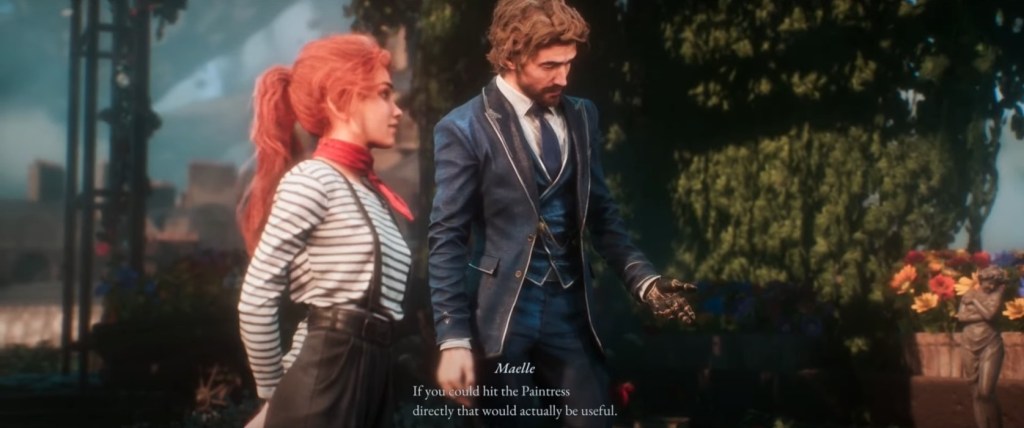
GUSTAVE
You know, hobbies don’t always have to be useful.
I’m enjoying the uselessness of today, and readying my usefulness for tomorrow.
And soon we’ll get to do a lot more than throw rocks.
An important message about the value of hobbies from a game that’s very much about the arts.
Then, there’s the hint as to what’s to come. We’re going after the Paintress with all we’ve got, and it’ll involve attacks far more impressive than a thrown rock.
Gustave’s determination to take down the enemy is a fifth bond-building trait.
Another beautiful shot of characters looking out at the Paintress and the glowing number above her. This will echo through much of the game, but this shot in particular will be called back at the end of Act 1, making the moment even more significant.
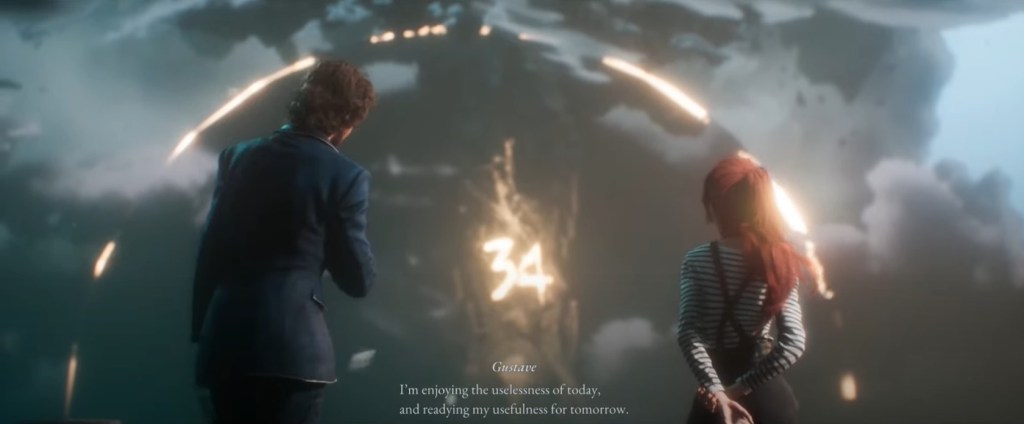
MAELLE
That’s what all the other expeditions said, too.
GUSTAVE
Heyheyhey. You know, you know they gave their lives to lay the trail for us, right?
MAELLE
Yeah, I know, sorry.
GUSTAVE
Yeah.
Maelle reveals she isn’t hopeful the expedition will succeed, in part because there have been multiple previous attempts that have all failed. And from Gustave’s reply, it sounds like no-one returned from any of them.
The stakes have been upped, and the scale of the task in front of us begins to take shape.
Gustave also displays another admirable trait for us to connect with: honour. That’s six.
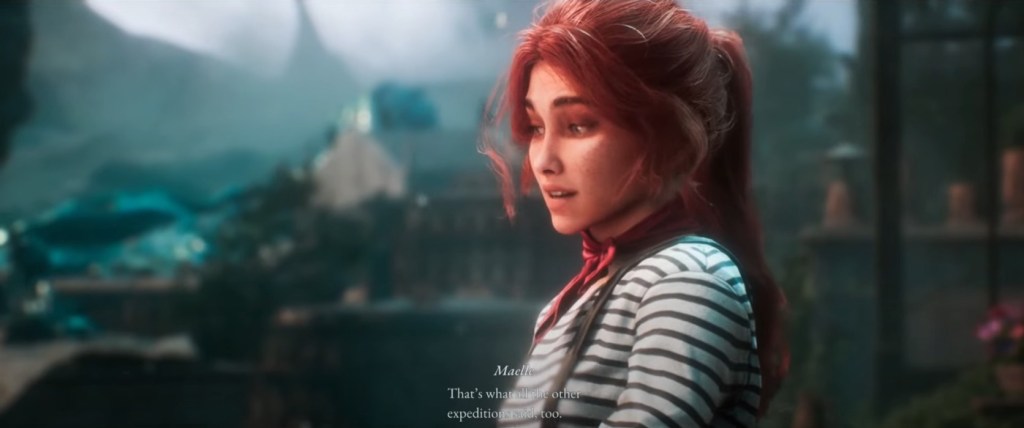
It’s interesting that it’s Gustave’s turn to lift her spirits, gently telling her off, almost like a parental figure, as much as they banter like siblings.
Gustave clearly believes passionately in the Expedition — that it’s necessary, and that it can be successful this time despite the failures of the previous attempts.
Maelle changes the subject…
MAELLE
You still got a flower to give, no?
The red rose looms large in the frame. Gustave’s more apprehensive about this delicate flower and what it signifies than he is about facing the Paintress and his probable death.
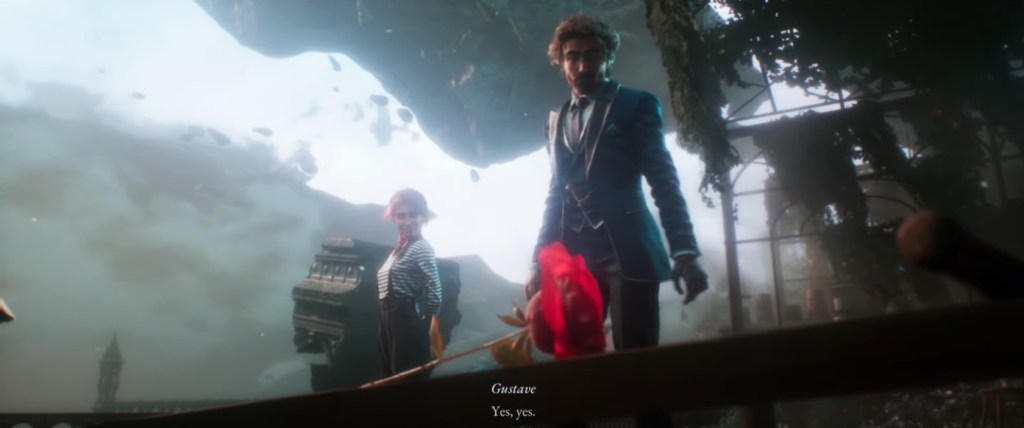
GUSTAVE
Yes, yes.
It’s just… I’m not sure how to start.
After four years apart, what do I say to her, on the day of her Gommage.
Now we know (part of) the reason for Gustave’s trepidation: he and Sophie used to be an item, but broke up four years ago. He undeniably still has strong feelings for her. Vulnerability: attractive trait number seven.
We also hear what’s happening to Sophie today. It is her “Gommage”. We don’t yet know what that is, but they’re talking about it as though it’s final, as though this is his last chance of putting things right with her. Again, the stakes rise.
MAELLE
You’re asking ME? I dunno, sun’s about to set, so… be direct?
“Hey Soph-“
“-been a while. Could we-“
Maelle gives us a clearer deadline: sunset. It’s imminent, which we can tell from the golden glow of the lighting too. No time to lose, yet Gustave’s been procrastinating. He’s struggling with the situation, which Maelle admits she hasn’t been in; unable to offer wisdom, she serves up more banter.
Although the conversation finishes on a joke, as it started, the weight on Gustave’s shoulders hasn’t lightened any. He knows he can’t put it off any longer.
Time for action.
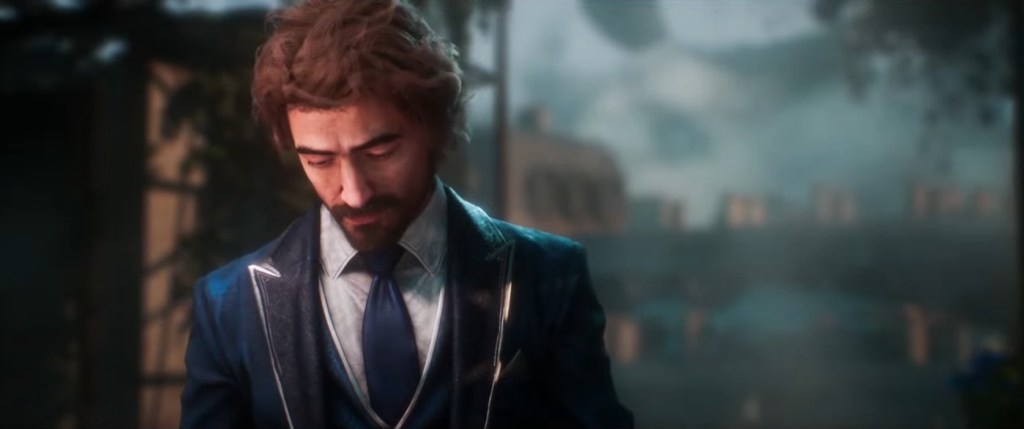
And this is where we take control.
It’s a delightful scene, with some funny moments, some deep moments, and we learn a boat load of information in an elegant way. All in just three minutes. It’s efficient storytelling of the highest order.
We’ve been introduced to the world, two of the main characters, and the enemy; we know our main objective is to take down the Paintress, which has proven impossible in the past; and we have our mini first objective: give the flower to Sophie. That can’t be too bad, right?
Right?
That scene is worthy of a deep dive too, as are many scenes in this masterpiece. If you want me to decode anything else, whether from this or from any other game/film/show, let me know in the comments.
 Arrowmaker Books