
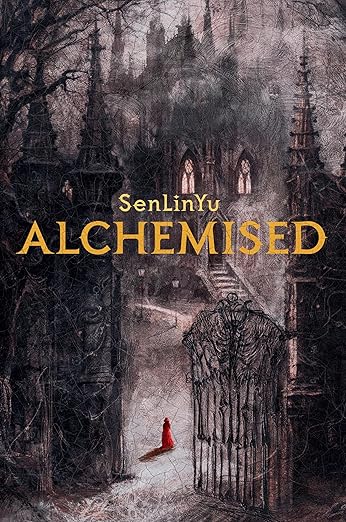
Alchemised by SenLinYu is one of the most discussed books of 2025, and will live long in my memory for both good and bad reasons. If you haven’t read it yet but think you might, I highly recommend you don’t read the two sections marked as having spoilers below – this book is best experienced with as little prior knowledge as possible.
an_author’s_review(no_spoilers)
First, a brief synopsis:
The war has been lost. One of the last surviving members of the defeated, a seemingly unimportant healer, is found with no memory of the months leading up to her capture, and one of the most powerful and ruthless necromancers is tasked with recovering her secrets.
I understand Alchemised is based on a Harry Potter fanfiction called Manacled; I haven’t read that, and wasn’t aware of it until after I’d finished. This read like a self-contained tale within it’s own world, and I certainly would never have guessed any kinship with the Potter-verse, although I haven’t read those books or watched those movies.
This review treats Alchemised as a standalone entity.
It is an incredibly dark story. There’s a warning at the beginning which points anyone concerned to check a list of triggers at the back of the book. I won’t repeat it because it’s also a list of spoilers, but suffice to say, there’s not much else that could have been added to make it worse.
I would not describe it as overly graphic – there’s nothing that made me turn away from the page – but be aware this isn’t a feel-good read that’ll make you feel all fuzzy inside.
It’s a very long story, too, at 1,024 pages. I wasn’t as bothered by this as some other reviewers who claim it’s bloated, but I think the first two parts could have been a bit shorter without losing much; they became a little repetitive. Part three could have been a little tighter, but moved quicker than the earlier parts.
The book spans years, and focusses on gradual change, so it’s logical for it to be lengthy.
I’ve seen Alchemised listed in the fantasy and romance genres. No argument with it being a fantasy, but whilst the story revolves around the central relationship between Helena (the captured healer), and Kaine (a VIP from the winning side of the war), calling it a “romance” feels like a misnomer. I certainly didn’t find it romantic; I discuss this in the final spoiler-filled section below – do not read that if you haven’t yet read the book but intend to.
With the exception of the epilogue, the book is told solely from a third person perspective limited to Helena, and there’s a lot of interiority – every touch and every emotion is detailed, so we see and feel what she’s seeing and feeling, which is often unpleasant.
Some of the descriptions of character reactions were repeated regularly, perhaps too often, but it also makes sense that a person would consistently react the same way. It wouldn’t have been so noticeable if the book hadn’t been so long and the characters weren’t put through so much.
Otherwise, I found the writing quite evocative without descending into extended, overly verbose passages. Despite the often difficult subject matters, I was never dissuaded from reading on, and I have to put my enjoyment of what is some bleak stuff down to the quality of the storytelling.
There were a couple of plot inconsistencies that niggled and prevented full marks, but reading this was such an experience that I couldn’t give it any less than…
My score: 4 out of 5
the_controversy(SPOILERS)
Aka the Alchemised rape controversy.
In part one of the book, The Bad Guys decide they want a baby from Helena. If the father is a powerful man, their combined abilities should result in a formidable offspring.
Kaine is ordered to impregnate Helena against her will.
We experience the first instance from Helena’s point of view (though not in first person), and at that time, it undoubtedly meets the dictionary definition of rape.
rape (verb): to force someone to have sex when they are unwilling, using violence or threatening behaviour
It fortunately (and wisely) avoids explicit detail, but it’s still deeply unpleasant to read.
We do, however, need to consider the situation from the side of the other person involved, and this is where it gets delicate.
Kaine doesn’t want to rape Helena. He is ordered to, and is told that if he doesn’t, someone else will. He’s reluctant before, clearly troubled during, and unwell after. We’ve been shown he’s a monster, but these actions don’t tally with that.
It’s only later, in part two, that it’s revealed events were not as straightforward as they seemed.
Helena and Kaine had been in a relationship. A troubled relationship, certainly, but she had willingly slept with him previously. In fact, she had wiped her memory to protect him.
Is it still rape? By the definition, yes. From Helena’s perspective at that time, without her memory of their relationship, it’s nothing short of horrifying.
From Kaine’s perspective, there were no good choices. If he’d refused to follow orders, he would have been punished (we see during part two how horrendous some of his prior punishments were, keeping him on an incredibly painful edge of death), and Lord knows how bad it would have been if they’d discovered he was a spy. He couldn’t have prevented the rape – someone else would have done it instead – and it could have been part of his decision-making that he could make it less bad for her than A.N. Other certainly would. Also, he could justifiably assume that, once her memory returned, she would prefer her baby to be his, and that to give birth to the child of any other rapist would be worse.
Following orders, as he did, he would have been aware that she may never forgive him even if she did get her memories back. Being forced to put someone you love through trauma is in itself traumatic, hence his reluctance beforehand and his vomiting afterward.
As a man, I perhaps can’t fully appreciate the fear of rape. But I can appreciate how impossible the choice was that Kaine had to make – to hurt the woman he loved to prevent even worse harm – and that was harrowing too.
I didn’t feel it romanticised rape, or excused rape. It was clear it impacted both characters afterwards, and I felt Helena was better able to get past it (after her memory returned) because she appreciated Kaine only did it as the least bad option. I’m not sure Kaine ever forgave himself.
do_anything_for_love?(SPOILERS)
As alluded to in my review above, my biggest issue with Alchemised is it being considered by some to be a romance.
I don’t know the author’s intention when writing the core relationship, but to me, it wasn’t really love between Helena and Kaine. It was mutual dependency brought about by each feeling isolated and alone, for different reasons.
Kaine was traumatised watching his mother be tortured and then die, despite him becoming a murderer in an effort to save her.
His father was at best dismissive, at worst, abusive.
Helena was the victim of discrimination over gender, race, religion, and her natural abilities. Her selfless efforts to help others were abused, until she was used as a bargaining chip.
They were both crying out for companionship, intimacy, and someone they could trust to look out for them. They were brought together by the shared secret of Kaine working as a spy; each became a crutch for the other, then an obsession, then a dependency.
That interdependence lead to truly despicable acts.
Love is never a reason to commit murder. And going that far for another person isn’t romantic, it’s monstrous.
The worse the acts they carried out, the further they slipped from everyone else, and the greater their interdependence. It was self-fulfilling, or ouroboros: a snake or dragon eating itself, as on the floor of Kaine’s house, and the hardcover of the book.
In the end, they weren’t living happily ever after. They were together, in the same place, but they were ostracised, away from everyone they care about, even their child.
Kaine would wander the perimeter of their property alone. We don’t see them enjoying spending time in each other’s company.
Both were broken, physically and emotionally. They hadn’t made each other stronger or better – they had destroyed themselves, and countless others, to selfishly keep the one person they felt they needed. And Kaine, in particular, showed no regret.
So, is Alchemised a romance?
The dictionary describes a romance as “a story about love”. The characters believed they were in love, and their relationship is the spine of the book, so technically, yes.
But I think this is an unhealthy kind of relationship to swoon over, and I worry for anybody who aspires to this level of “love” – and anyone they hurt along the way.
A list of the book reviews posted to my blog is here.
 Arrowmaker Books