
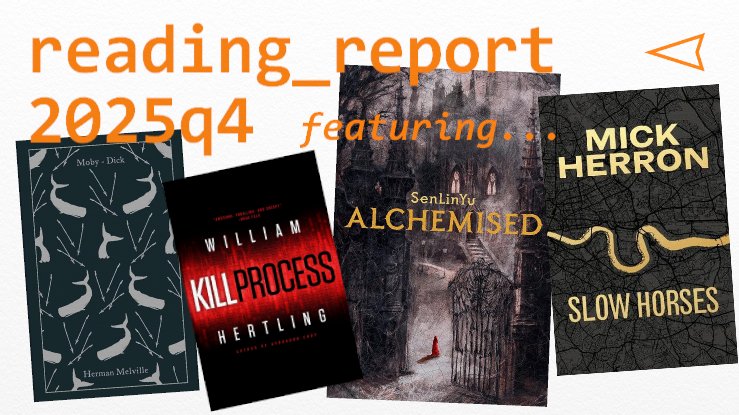
For 2025, I set a conservative target of reading twelve books. After the first nine months, I’d already blown past that, having read these nineteen:
- What You Did by Claire McGowan
- Orbital by Samantha Harvey (full review here)
- Amatka by Karin Tidbeck
- The Infinite and the Divine (Warhammer 40,000) by Robert Rath
- Penpal by Dathan Auerbach
- The Final Empire (Mistborn Saga #1) by Brandon Sanderson
- Mirror Me by Lisa Williamson Rosenberg
- The Ghost Writers Club: A Novel by Cody Wayne Morris
- Dracula by Bram Stoker (full review here)
- The Sandman Vol. 2, Vol. 3, Vol. 4 by Neil Gaiman
- Leviathan Wakes (The Expanse #1) by James S A Corey
- Animal Farm by George Orwell
- Kill For Me Kill For You by Steve Cavanagh
- Yellowface by R.F. Kuang
- Dissolution by Nicholas Binge
- Blood Slaves (The Blood Saga #1) by Marcus Redmond
- Annie Bot by Sierra Greer
You can see my thoughts on the first four in my Q1 report, the next five in my Q2 report, and the remaining ten in my Q3 report.
In this last quarter, I read only four, but two of them were monsters.
That takes my total for the year to twenty-three.
I was tempted to read something short over the last ten days to make it twenty-four – double my target of twelve – but wanted to read something else instead (more on that later).
Ok, intro over. Here’s the books I read in Q4 of 2025…
1. Moby-Dick by Herman Melville
A whaling captain obsesses over catching the whale that took his leg.
In the previous quarter, I read Animal Farm and it was clear why that was a classic. This, not so much.
The story is mostly told by someone who has no obvious impact on proceedings; I say mostly because later chapters shift in and out of a third-person perspective. The opening act spends a lot of time introducing the relationship between two men, leading you to think they’re the main characters, but one of them is barely mentioned once they get on the boat, so all that time felt wasted. Numerous chapters are spent describing the technical details of whaling boats and the biology of whales, and much of it feels more like a textbook than a novel. Towards the end, it seemed like the author ran out of steam: there are chapters of just dialogue, without even one tag to identify who’s speaking; and SPOILER the whale they’re chasing, Moby-Dick itself, appears only in the last 5% of the book END OF SPOILER.
In this state, this would surely never get published today, and I think that’s a good thing. I found it a chore to read.
The prose is long and flowing, arguably too long at times, but was actually the one bright spot, and was beautiful often enough to gain this book one point over the minimum.
My score: 2 out of 5
2. Kill Process (Kill Chain #1) by William Hertling
A vigilante hacker working for the world’s biggest social media company decides to setup a competitor that will prevent any other site having the same monopoly.
A technothriller that doesn’t scrimp on the tech. I’m no hacker or programmer, but I know a bit about computers, so it’s difficult for me to tell if the uninitiated would be able to follow all the detail; but even when the described tasks and terms were outside my knowledgebase, I was never lost or confused.
I thought the first act was drawn out a little too long, enough for it to get repetitive, but once the second part of four began, it picked up, and the last act brought the thrills.
The main character was a little different for this kind of book – female(!) abuse survivor with one arm – and her traits weren’t just window dressing, they fed into the plot and impacted the character relationships throughout.
It felt well researched and well planned out, and I’m looking forward to reading the follow-up.
My score: 4 out of 5.
One of the last survivors of the losing side of a war is discovered with her memories blocked, and a necromancer is tasked with unlocking her secrets.
This isn’t the favourite of my reads this year, but I suspect it will be the most memorable. It’s very long at 1,024 pages, and whilst it got slightly repetitive a couple of times, I was always keen to keep reading. It was one of the few books where I felt compelled to write about it afterward: you can read my full review and analysis of it here.
My score: 4 out of 5.
Spies put out to pasture find themselves involved in efforts to prevent a racist beheading.
Reading Slow Horses was an odd experience because this was the first book I’ve read where the style and tone felt similar to my own. There were some really great turns of phrase, and the story, once it got going, was enjoyably twisty, as required in the spy genre.
I had some issues with it, though.
Almost all the main characters were introduced at once at the beginning, which made remembering who was who tricky. The author went for fast-paced dialogue and often omitted tags (names of who was speaking); I don’t have a problem with this when there’s only two people talking as it’s easy enough to follow the back and forth, but when there are up to four, it made it difficult to decipher, and led to many of the Slough House characters feeling like one hodgepodge rather than individuals. Part of the plot hinged on conveniently-timed memory recall, which felt weak.
From a technical perspective, I would have given it 3 out of 5, but I enjoyed it enough to give it…
My score: 4 out of 5
And that’s it for the past three months, and 2025. It’s been my best reading year since I was a kid, possibly ever, and I’ve enjoyed it (despite the duds).
The biggest disappointment was Kill For Me Kill For You by Steve Cavanagh, which remains the only book to have made me angry. You can read my evisceration of that on my Q3 report.
For my favourite, I can’t pick between two: The Final Empire (Mistborn Saga #1) by Brandon Sanderson; and Leviathan Wakes (The Expanse #1) by James S A Corey. Both were top-notch, and I’m looking forward to continuing both series in 2026.
Special mention to Alchemised by SenLinYu as well, that will stick in my mind for a long time, for both good and bad.
Up next, I’m reading The Blacktongue Thief by Christopher Buehlman.
For 2026, I’ve set a target of eighteen.
I don’t want to go too high because I have a few chunky books in my TBR pile, especially sci-fi and fantasy. I want it to continue to be achievable and enjoyable, not a burden.
If you want to keep up to date on what I’m reading, you can follow me on Goodreads.
What did you like or hate reading this year?
If you have any recommendations, please leave them in the comments. Thanks!
 Arrowmaker Books