
Blog season 2, episode 6: fight!
How do you spend your free time?
You won’t read any sermons or guilt trips here. But if you’re struggling with the motivation or discipline to spend more of your spare time creating your masterpieces instead of numbing your tired brain, I have a simple system I hope will help you.
This is how I increased the amount of free time I spent on my writing by 80% within a month.
It isn’t magic. It won’t work for everyone.
It’s not about increasing the amount of free time you have; it’s about increasing the proportion of it you spend on your chosen goal.
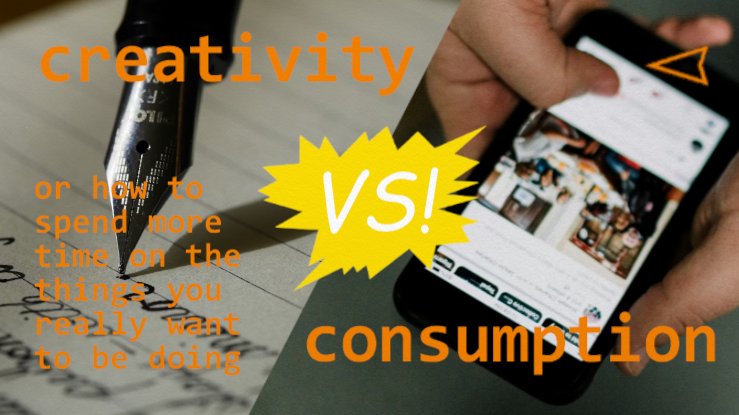
Creativity and consumption compete for every spare minute. When you have a choice between them, consumption is quicker, easier, more seductive. Starting a creative session takes more effort.
A key part of this plan is to reduce or remove that disparity.
how does it work?
In as simple terms as possible:
Record the time spent creating.
Record the time spent consuming.
Compare the two.
I keep a spreadsheet, with two separate lists. One is for creativity, the other is for consumption.
On each, I record the date, the time I start, and the time I stop; it calculates the amount of time spent in that session.
It forces me into a conscious decision whenever I have free time. I have to enter the details into one sheet or another – what do I really want to do?
I have a third table which calculates the total time spent on creativity and the total time spent on consumption per week, and gives a percentage of the total time that I spent creating.
Having the running percentage available as the week progresses enables me to judge my performance against my target, and adjust accordingly. I wouldn’t want to adjust down and reduce my creative time, but if I know I’m ahead of schedule and am feeling drained, I can allow myself some relaxation time.
Selecting a target that’s achievable, but isn’t too easy, is key.
A goal that’s either too hard or too easy can be discouraging.
My target is 50%, for an even split of my free time.
If you already track your creative progress, as many writers do, you’re halfway there.
Additionally, although this isn’t necessary, I keep a very basic record of what I created or consumed, and look at patterns – this helps identify any habits I might want to change.
rules to live by
Like any system, it relies on a few rules.
If you don’t apply your rules consistently, this system will not work.
Below are the rules I’ve found work for me. You can of course add, change, or remove your own rules as they best apply to you.
- Time spent doing chores does not count as free time, so is not recorded on either list.
- Time spent catching up on current affairs (eg reading the news) is not recorded on either list.
- Anything consumed whilst doing something else (eg listening to music whilst doing chores, watching TV whilst eating dinner) is not recorded on the consumption list.
- If the content being consumed runs longer than the length of time it takes to finish the chore/meal, the overrun doesn’t need to be recorded either, within reason (eg it’s not ok to avoid listing a two-hour film because I ate a sandwich when it began).
- Time spent deciding whether to create or consume is not recorded on either list.
- Time spent on social media for my writing is not recorded on either list, because it falls into both; time spent on social media generally browsing or interacting with friends is recorded on the consumption list.
my results
I didn’t expect to see as much improvement as I did. It quickly became something that isn’t much of a chore, but still has an impact.
In my first full week of recording my creativity vs consumption, I spent 30% of my free time working on my writing. By my fourth week, that had increased to 54%.
For the past eight weeks, it’s hovered around the mid-forties (excepting Christmas week when I allowed myself more relaxation time but didn’t stop writing every day – I still hit 41%).
I do at least 15 minutes work on my writing every day, and have posted previously about how I maintain that consistency. That streak has continued since and, as at publication of this post, sits at 593 days.
In the two months before I began this system, I averaged 8.5 hours of writing per week.
In the two months after, I averaged 15 hours of writing per week.
I put that increase solely down to this system.
more?
If you want me to provide a downloadable Excel spreadsheet for this system, please leave a comment.
If you try this system, please let me know how you get on.
If you have any suggestions or questions, I’d love to hear them.
credit due
The idea for this system first came about when I was watching a vlog of AuthorTuber Sara Lubratt. She made one fairly innocuous comment whilst talking about wanting to write more regularly: “I just really want to focus more on creating over consuming again.”
My brain received this information and spat out Creativity vs Consumption: if I make it a direct competition, I might create more.
Sara’s channel is full of good videos that I watch for motivation.
Featured image background photos: pen by Aaron Burden; phone by Priscilla Du Preez (both on Unsplash)
 Arrowmaker Books