
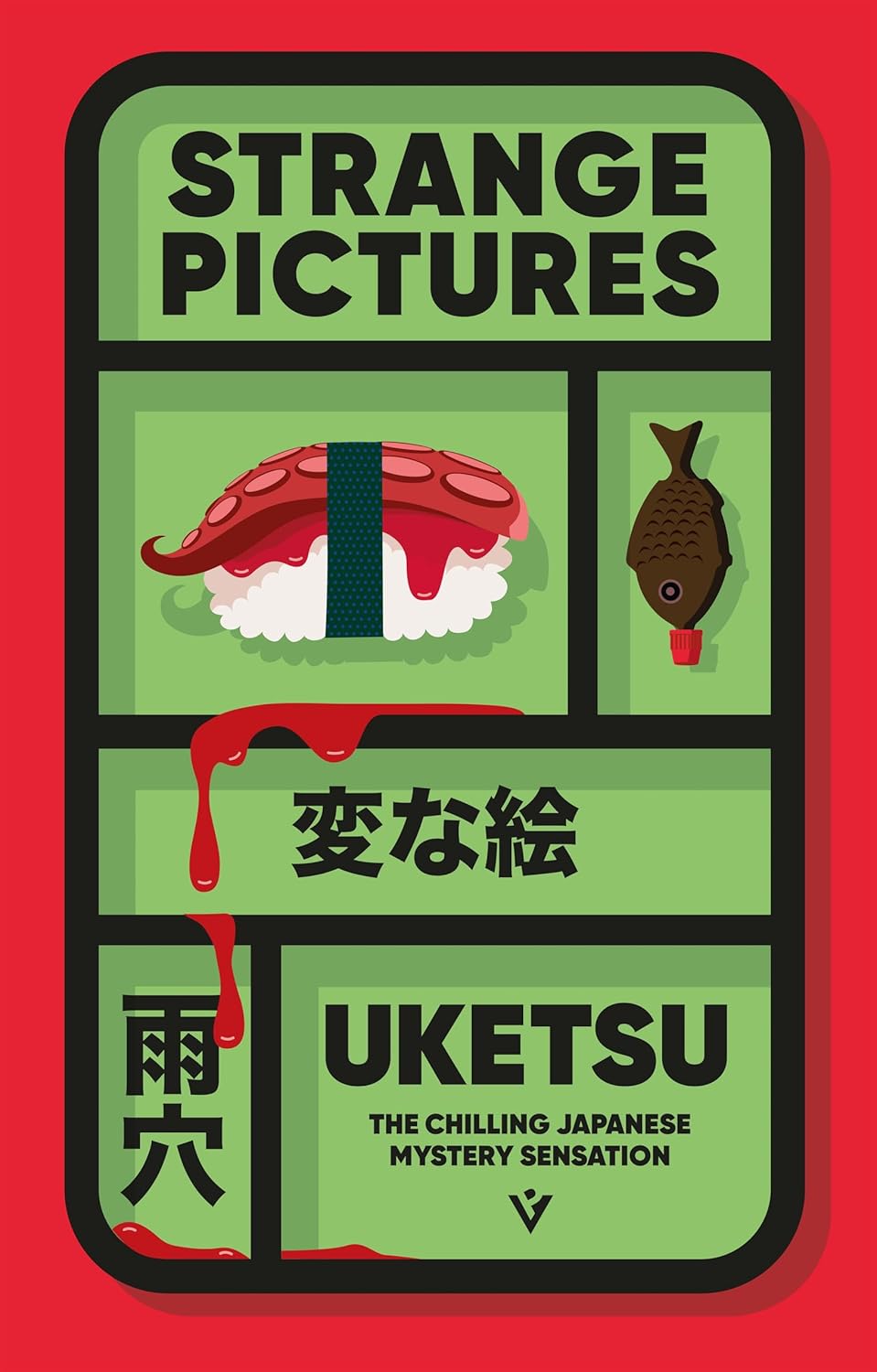
I liked the strangeness of Strange Pictures by Uketsu (translated by Jim Rion) but little else.
Whilst the central mystery was very detailed, perhaps overly so, the other facets were mere rough sketches, and the book as a whole suffered as a result.
As with all my reviews, I’ll be objective about the writing technicalities, and specify where I feel something is valid but not to my taste. My final rating will be an average of my objective score and my personal opinion.
There are no spoilers in this review.
So what is it?
short_synopsis
A murder mystery revolving around a variety of drawings. The less you know beforehand, the better.
plot
The machinations of the story are the showpiece of this book, and it’s clear this is where the author devoted most of their attention.
It begins with a short prologue to introduce the concept: it shows us a picture, then explains with close-ups how we can deduce certain facts pertaining to the story. The book wouldn’t work without the pictures, they’re baked into the story.
There are four subsequent chapters. At first, they appear unconnected, but it’s gradually revealed they’re all linked. I thought the overall arc was quite good, but many of the details and arguments back and forth by characters were unnecessary and sometimes illogical.
I’ve seen this categorised and described as a horror, as well as a mystery, which I don’t understand. I didn’t see anything in this that would classify it as a horror.
people
I think this book would have benefited from less time spent on the little plot details and more spent on the characters. They don’t feel like individuals at all, just pieces to be moved around to fit the story, and there’s not much to differentiate them from each other. Everything is explained rather than shown, so there’s little to connect with.
The telling of the story skips between multiple characters. Because they’re difficult to distinguish between, even labelling the sections with the character’s name doesn’t completely prevent confusion. I often needed to remind myself who each person was, perhaps partly because I read it over the course of 12 days (despite it being quite short at 238 pages); it may have been easier to follow if read in one or two sittings.
The dialogue was almost exclusively expository, and sometimes cringeworthy in how on-the-nose it was, with characters telling each other things they would obviously already know just to communicate the facts to the reader.
place
Where or when we were was treated almost as an irrelevance, except for when it was vital to the plot. Even then, there was very little description that could put us in the character’s shoes.
prose
For me, this felt more like a puzzle book than a novel, with a writing style akin to a report. It’s arguable how much of this is down to the author and how much is due to the translation, but I can’t imagine the translator omitted passages of description that would have brought the world and characters to life.
You might not mind if you’re reading it purely for the puzzles, but I expected more.
conclusion
I think part of the reason for my disappointment is thinking this was a novel. If it had been in the puzzle section of the store, I would probably have been more satisfied.
Whilst I can appreciate the effort to do something different, this didn’t work for me. I sincerely hope other authors take this idea and add their own spin to it with characters I can connect to.
As it’s being marketed and sold as a novel, I have to score it as one.
My score: 2 out of 5
A list of the book reviews posted to my blog is here.
 Arrowmaker Books