
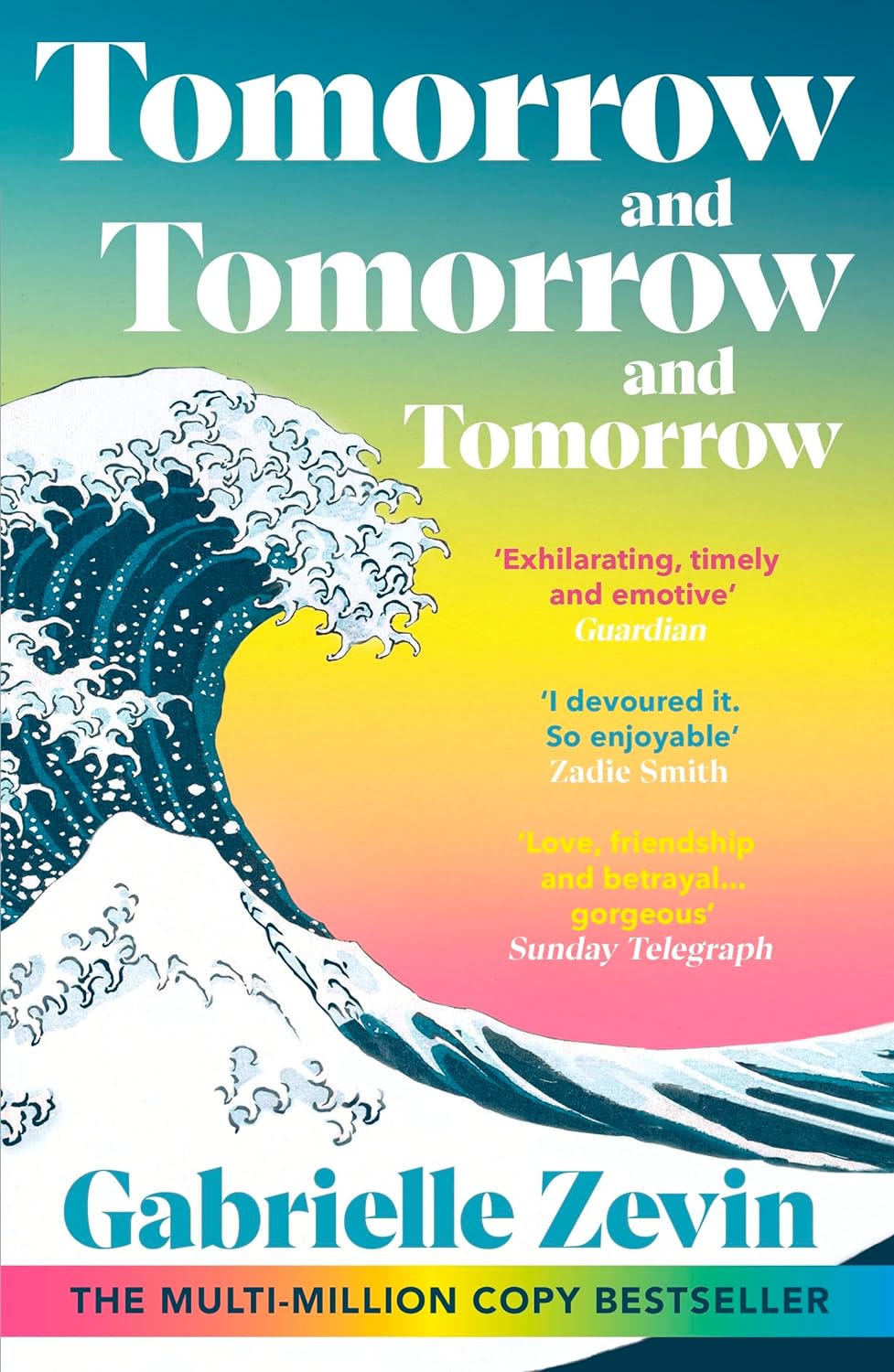
Whilst Tomorrow, and Tomorrow, and Tomorrow by Gabrielle Zevin doesn’t sparkle in any one area like other books I’ve read recently, it doesn’t have their weaknesses either, and is strong across the board.
As with all my reviews, I’ll be objective about the writing technicalities, and specify where I feel something is valid but not to my taste. My final rating will be an average of my objective score and my personal opinion.
There are no spoilers in this review.
So what is it?
short_synopsis
The ups and downs of friendship between two computer game designers, pitched as a love story without the romance.
plot
The story centres around two best friends from when they meet as boy and girl in a hospital, through to becoming successful and established computer game designers together.
Its split into different sections. The subjects of the games the main pair make are reflective of their emotional state at that time, which is clever but basic “good” writing; it takes it to the next level for one of the sections, “Both Sides”, where the structure of the game reflects back into the composition of the chapters. Later, there’s a section completely based inside one of the games. Touches like this add welcome variety in what is a relatively gentle tale.
Whilst no technical understanding of games and gaming is required, they are the frame within which the story is painted, so some knowledge or interest is recommended.
I felt the finale missed an opportunity, but it finished on a natural note and I wasn’t unhappy with the way it left things.
people
The two main characters, Sam and Sadie, are well-drawn; they have different backgrounds and traits, but their friendship and connection, and their struggles, felt genuine.
Some reviewers took a dislike to Sadie that I personally didn’t share. Both characters were imperfect in a realistic way.
There is a third character just below the two leads who is deliberately boring (described as an “NPC”) so as to not divert attention from the headline relationship. Most of the second-level cast felt like individuals too. Some of the very minor characters slipped into caricature, which wasn’t a problem except for two: they appeared briefly but made a major impact and a political point; I would have preferred more subtlety.
place
In stories that occur over decades and that move between multiple locations, it can be difficult to build a cohesive, living world. As the setting wasn’t fantastical, it didn’t need to spend as much time giving us a sense of where we were, and more time was spent internalising the characters than looking at the externals. In a story about the relationships between people, this made sense.
There were moments of social commentary that felt integral to the story and weren’t clunky, but one or two scenes could have been a little less heavy-handed.
prose
The writing is good without being showy or overly complex. That isn’t to say it’s dull; it’s very readable. I got the impression it was trying not to draw too much attention to itself, and as a result let the characters and story shine.
conclusion
It was nice to see computer games treated as the art they are by a more established form, and to read a central relationship between a man and a woman without it resorting to a will-they-won’t-they.
I don’t have any major complaints, only a couple of niggles, and whilst I wished the ending was a bit more, I enjoyed the reading experience.
If you have no interest or knowledge of games, this perhaps isn’t for you; likewise, if you need thrills or tension. But if you like cozy games, this might be the book you didn’t realise you were looking for.
My score: 4 out of 5
A list of the book reviews posted to my blog is here.
 Arrowmaker Books