
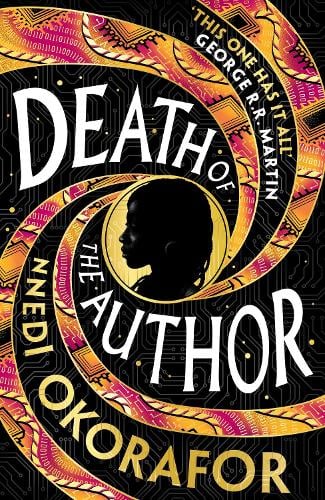
Death of the Author by Nnedi Okorafor is a hybrid science fiction/literary fiction with a twist.
As with all my reviews, I’ll be objective about the writing technicalities, and specify where I feel something is valid but not to my taste. My final rating will be an average of my objective score and my personal opinion.
The only spoilers are in the final section analysing the ending.
So what is it?
short_synopsis
A disabled, unemployed woman writes a book about robots; and a post-humanity robot tries to save the world.
plot
The chapters are split into three different strands.
The most prominent strand, with the most chapters devoted to it, follows Zelu, a wheelchair-bound Nigerian-American with a judgemental family, who loses her job and writes a novel titled Rusted Robots.
The second is from the perspective of a robot in the future, Ankara. Obsessed with collecting the stories of humans, Ankara discovers the end of the world is nigh and tries to save it.
The third strand, less prominent than the other two, is a series of interviews with people close to Zelu. To me, these interviews felt a little superfluous as the other characters’ opinions about Zelu were pretty clear from the main strand anyway. Theses chapters didn’t detract either, so no harm done, but a little strange.
The book took a few chapters to draw me in. This may have been my own failing as it’s quite heavy with cultural references I didn’t have experience of. It’s arguable whether readers could/should have been eased in more to avoid putting some people off before the story properly gets going, but I don’t resent the author’s choice at all.
As it neared the end, it played up the danger of each scenario Zelu found herself in, teasing the reader. Given the title, it’s a fairly obvious thing to do, but it’s done well.
Whilst the robot’s story was building to its conclusion, the author’s storyline drifted and felt aimless. If there’d been more tension in Zelu’s story, it would have fed into Ankara’s, but instead it slowly fizzled out. Given that, the ending was far more satisfying than I feared it would be, but I can’t write why without spoiling it – see below for my spoiler-filled analysis.
people
Zelu reads like a fully-formed character, helped by having believable and understandable flaws. She’s not the most likeable person, but I was never disappointed or annoyed to spend time in her company – in fact, I preferred her chapters over those from the other strands. She was different from the rest of her family, and that contrast made her feel more like an individual.
I suppose it’s natural I connected less with the robot. I found Ankara less interesting, with less human-like qualities and quirks. The love story (of sorts) with Ijele, a different type of AI, was interesting but not touching, to me at least. If these were deliberate choices by the author, then they worked well.
place
Much of Zelu’s story is set in America, but the chapters set in Nigeria are much richer, with both the positives and the negatives of the culture intertwining with the plot and characters. Again, it’s the contrast here that worked well and made the locations feel more real.
Ankara’s world was comparatively bare, but this vision of a world where robots have outlived humans was intriguing.
There’s plenty of commentary here, covering racism, ableism, family pressures, technology, climate change, social media, fame, and AI.
prose
The writing had a nice flow to it; it was never clunky, and there was the occasional well-placed flourish that never felt over-the-top.
A funeral was especially beautifully written, and was evocative and touching.
There were a few items that were mentioned repeatedly to the extent it felt intentional, but I couldn’t discern a reason why and it came across as a little odd. Perhaps they were references I’m not aware of.
conclusion
In a gutsy move by the author, on page 11, Zelu criticises storytelling that’s “plotless, self-indulgent, and full of whiny characters who lived mostly in their minds”. I can’t turn down an invitation like that, so…
This book wasn’t plotless (although Zelu’s story ran out of steam). It wasn’t self-indulgent. I wouldn’t describe any of the characters as whiny, although Zelu was fierce, opinionated, and selfish. And whilst a lot of Ankara’s story took place in his mind, that was with the other AI, Ijele.
I haven’t read anything quite like this before, and I’m pleased to have discovered it.
If you’re a sci-fi fan who doesn’t like litfic, you might struggle with Zelu’s sections which are the majority of the book.
If you’re a litfic fan who doesn’t like sci-fi, Ankara’s sections aren’t overly intrusive that you can’t enjoy this.
If you like both sci-fi and litfic, this is definitely worth reading.
My score: 4 out of 5
analysis_of_the_ending(SPOILERS)
At the end of Ankara’s story, the robot saves the world by creating a unique story, something previously thought impossible by the AI themselves.
2025 is a wild time to put out a book that has an AI writing any story, let alone the tale that’s the saviour of the planet. For most writers, the nightmare of AI authors is more likely to bring about the apocalypse than stop it; this is even referenced in the last chapter. But the assertion appears to be that AI is our creation too, and all creation is good and all creation feeds further creation. If that’s the intention, I can’t agree.
From the beginning of Death of the Author, we’re led to believe Ankara’s story is the book Zelu wrote, Rusted Robots. The final chapter reveals that Ankara’s story that saved the world was about Zelu – therefore the chapters about Zelu that we read previously were in fact the story Ankara wrote, and we had the “real” world the wrong way around.
This is supported by Ankara’s chapters being in the first person and Zelu’s being told in third person past tense.
It’s a fascinating twist, deftly executed. Reveals that put a different perspective on everything you’ve read up to that point are difficult to pull off believably, but when they work, they hit hard.
I’m a little confused what the strand of interviews is intended to be, however. Are they supposed to have been written by Ankara as a part of the story? That wouldn’t make much sense. Were they documents Ankara collected, that he used as inspiration for the story? Maybe, but that’s not even implied. I was dubious about their value before the twist, and find them even more odd now.
They didn’t impact my score up or down; they’re more of a niggle than anything.
I’m not generally in the habit of rereading books (my TBR is too large), but this is one I’ll be tempted to read again to see what difference the new knowledge makes.
A list of the book reviews posted to my blog is here.
 Arrowmaker Books