
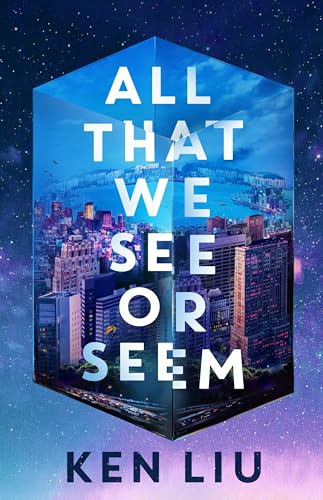
As a technothriller, All That We See or Seem by Ken Liu should have been right up my alley. It isn’t the worst book I’ve read so far this year, but it’s in the bottom half. What went wrong?
As with all my reviews, I’ll be objective about the writing technicalities, and specify where I feel something is valid but not to my taste. My final rating will be an average of my objective score and my personal opinion.
There are no spoilers in this review.
So what is it?
short_synopsis
A reformed hacker goes on the run to help a husband find his missing wife, a famous dream weaver, before a criminal finds and kills her.
plot
For a thriller, many of the twists or turns were completely foreseeable, the only real surprise being how early the main goal is wrapped up. The story then spins off into a mini-sequel that feels tacked on.
Twice, the story proceeds only with the solving of a code that, whilst the logic behind them is quite clever, there isn’t enough context for the person who is meant to solve them. For example, the missing wife leaves a puzzle for her husband, a non-techy lawyer, that’s so complex, it makes no sense she’d expect only him to figure it out. When the solution is discovered, the explanation for how it was worked out was insufficient and it felt like an unbelievable leap.
Advanced AI assistants feature heavily in this world, but we’re expected to believe the main character is more adept at finding patterns, which is a stretch.
The finale conveniently ignored previously established facts to attempt to add tension; instead they provoked frustration. And a “reveal” in the epilogue wasn’t surprising, it was fully expected.
people
Whilst the vast majority of our time is spent with the vigilante hacker Julia Z, this book is written from a few different perspectives. All of the characters feel like sketches or caricatures, pawns to be moved to further the plot without giving any reason to connect to them.
For example, the second major character is the lawyer husband of the missing woman, but that’s all he is – there’s very little to define him as a person other than his wife and his job; outside of those two things, I don’t remember a single hobby or interest being mentioned.
Side characters appear only long enough for them to perform their story function, then are discarded without adding any colour or interest. Reunions with old friends are unnecessarily hurried and impersonal, and were missed opportunities.
The “big bad” is bafflingly dumb for someone who got to his position of power, and the self-justifications for his actions were unbelievable even for a person that stupid.
The lack of a reason to care for any of the characters ultimately leads to a complete lack of tension when they’re placed in peril.
place
There are vague and inconsistent hints as to what time period this story takes place in, and it isn’t until chapter 20 that we’re given a real-life reference we can use to estimate how far into the future we’re being taken. Even then, it’s vague.
We’re never given much sense of the wider world – everything is focussed on our main characters and their predicament without giving us much context of what else is going on.
A couple of the pieces of future tech are quite creative, although at times they also felt a little too “magic”, particularly a small shape-shifting drone that features several times. There’s no real sense given as to how widely such technology is used or how it’s changed everyday life.
prose
There are some nice turns of phrase, but generally I’d describe the writing style as functional – it explains what’s going on without flourish. Personally, I would have preferred more detail across the board; for a 400+ page book, it lacked substance.
From chapter one, there is a lot of fictitious jargon. This isn’t necessarily an issue if it’s explained, or at least made understandable with context, but much of it isn’t.
The old adage of “show, not tell” is important because it’s more interesting to see and hear and feel something happen than to be told about it, but there’s a lot of telling so we’re never included in what’s happening. An early example: in chapter two, we’re told a character is an engaging storyteller, then instead of letting him tell the story in dialogue – showing he’s a good storyteller and letting us experience it – the author tells us the story.
Many of the action sequences felt rushed, occasionally with movements and feats that felt unbelievable even in a future setting.
There were some editing failures, including a bizarre occurrence of the incorrect character name being used twice on the same page.
conclusion
In a word, disappointing. In slightly more words, it was lightweight, soulless, dull. The biggest problem I had throughout was that it felt like we were being told the story, not being put in it.
Positives? There were some interesting tech ideas. Other than the made-up, insufficiently-explained jargon, it was an easy read. The story moved along quite briskly.
If you want to read a technothriller about a female vigilante hacker, I much preferred Kill Process by William Hertling, which I gave 4 out of 5. This was barely half as good.
My score: 2 out of 5
A list of the book reviews posted to my blog is here.

