
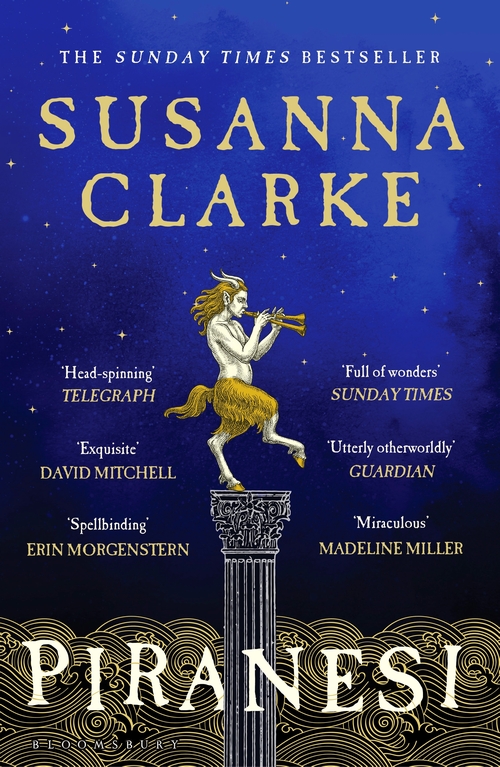
Piranesi by Susanna Clarke is prettily-written and wants to connect with everyone, but in the absence of a coherent message, failed to connect with me at all.
As with all my reviews, I’ll be objective about the writing technicalities, and specify where I feel something is valid but not to my taste. My final rating will be an average of my objective score and my personal opinion.
There are no spoilers in this review.
So what is it?
short_synopsis
A new person begins visiting the fantastical House that Piranesi calls home, and he must decide whether he should believe the Other’s claim the newcomer means them harm.
plot
The story is told as a series of journal entries by the main character, Piranesi.
The book takes its time showing us the world. Piranesi’s relationship with the Other (the only other person in the House), and their goal of finding an undefined Great and Secret Knowledge. The arrival of the new person takes even longer – it is probably necessary to setup the status quo before shaking it up, because it is unusual, but I do think it took too long in what is a short book.
There’s not many twists and turns, and not much in the way of surprise. Most of the questions it asks are answered, but not all. The main mystery is pretty obvious from very early. An oddity is introduced very late on and not answered, and I’m not sure even the author knows the answer to it; it feels like something added just to be mysterious.
There isn’t a specific theme, instead keeping the metaphors so vague they could have various meanings. This can allow each reader to assign their own meaning and connect to it in their own way. There is a skill to writing this way, but for me, it was trying to be too much to too many, and I’d have preferred it to pick a message and focus on it. If it had, it could have been really effective as the concept is very strong.
people
Piranesi, the lead and the writer of the journal entries we’re reading, is an odd character and a mass of contradictions. A few examples:
He’s methodical and scientific, carrying out experiments for the Other, yet worships the House beyond all reason. For example, he accepts the House is able to provide items for which the raw materials do not exist in this world.
He’s lonely, and suspects there may be people in the parts of the House he hasn’t explored yet, but hasn’t travelled that far too look for other contacts.
He fears he’s going mad when he finds words he doesn’t know, even though they are consistent with the statues throughout the halls that also refer to things that aren’t in the House.
The only other person in the House from the beginning, called the Other, is not nice to Piranesi, but he thinks of him as a friend. This is perhaps because he’s so lonely he’ll put up with him just to have contact with someone. To say much more about him would be a spoiler.
The new person that arrives is not in it much, and again, to say anything about them would be a spoiler.
place
The world is the star of this book. Much of the House is very stationary, with its countless halls and statues; the only movement comes from birds and fish, and from the tides and floods that swell in and out of the halls. There’s no electricity or technology, no plant life beyond seaweed. There are references to being able to see the sky, but no mention of being able to see anything else outside.
There is a certain majesty to it, mostly derived from the reverence Piranesi holds the House in. His documented struggles to find enough to eat and with loneliness do question why he hasn’t done more or travelled further in an attempt to improve his standard of living.
It’s an interesting world in need of a more interesting story.
prose
The writing in the journal comes across as a little simplistic, flitting back and forth between innocent and childlike.
At the beginning, I wasn’t sure if I needed to commit to memory the numerous hall “addresses”, such as “Third Northern Hall”, or the myriad statue descriptions like “woman carrying a beehive” that were used as landmarks, but it quickly became clear there were too many to remember. Of course, some do reoccur, but if you asked me what happened at which location in the story, I wouldn’t be able to tell you.
There’s an unusual stylistic choice of capitalising the nouns related to things inside the House. I couldn’t discern a reason for this, or if there was a puzzle to it that I didn’t get.
conclusion
There’s one major issue with this book that I struggle to get past: the Other owns and provides Piranesi with numerous items that could not be produced in this world, yet Piranesi never questions where they came from or how they were made. As a character who is analytical, records the tides, keeps a journal, and conducts science experiments, believing these items are provided to the Other somehow by the House is non-sensical.
Yes, it’s a fantasy novel so there needs to be some suspension of disbelief, but the world and the people in it still need to maintain a consistent logic.
In my opinion, it’s too vague in its messaging, being the literary equivalent of a love song that doesn’t specify whether it’s about a wife, husband, partner, unrequited love, family member, friend, or dog. It leaves it open for the reader to connect with how they like, but to me, it comes off as not being about anything. What does it mean? I don’t think the person who wrote it knows.
If you like that kind of thing, you’ll like this because it is well done, but it’s not for me.
And yet, between the moments of frustration, I quite enjoyed the reading experience, which makes rating this book rather tricky. Objectively, I think it’s a 4 out of 5. Personally, I’d give it a 2. So the average is:
My score: 3 out of 5
A list of the book reviews posted to my blog is here.

