
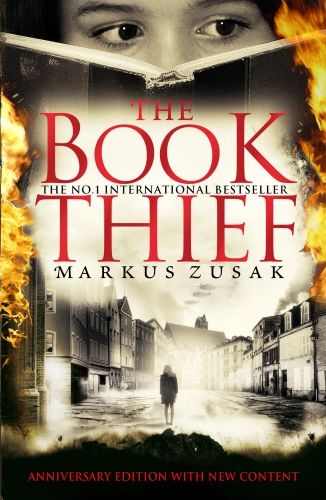
Writing with a light touch on horrible topics like World War 2 is a difficult balance, but is pulled off expertly in The Book Thief by Markus Zusak.
As with all my reviews, I’ll be objective about the writing technicalities, and specify where I feel something is valid but not to my taste. My final rating will be an average of my objective score and my personal opinion.
I use the following star scale:
1 = did not like it
2 = it was ok
3 = liked it
4 = really liked it
5 = it was amazing
There are no spoilers in this review.
So what is it?
short_synopsis
Death tells the tale of a young girl moving in with foster parents and shielding a Jew in WW2 Germany.
plot
The story is a slow burn but never dull. There’s always something interesting or amusing or challenging just around the corner, and the writing style keeps us moving even when the characters aren’t.
It begins with a young girl, the book thief of the title, travelling to her new foster parents with her biological mother and brother. On the way, her brother dies, and she steals her first book, a manual for gravedigging. Her foster father comforts her when she has nightmares, and in the nights, he teaches her to read using her stolen book.
She makes friends with the boy next door, and they have adventures together, including stealing more books.
After about one third of the story, a Jew arrives under cover of darkness, as a result of a promise made by her foster father, and they shelter him in their basement. They all become friendly, which adds a concern of what would happen to him on top of the fear of what would happen to themselves if the Nazis discovered him.
I can’t write too much about the finale without spoiling it. It’s very well done and packs an emotional punch.
The main themes are the power of words, the destruction of war, and the evil lack of logic of racism (specifically antisemitism). All are powerfully demonstrated and weaved into the fabric of the story.
people
This is slightly odd in that it’s told from the first person perspective of Death, but he very rarely talks about himself and his actions. He’s almost entirely focussed on the book thief and her foster family, friends, and acquaintances.
The young girl is a bit of blank slate at the beginning, frightened and grief-stricken from the death of her brother who was supposed to be fostered with her. The biggest influence on her is her foster father, who is tolerant, patient, and no lover of the Nazis. Her foster mother is not pleasant (at least in the beginning) and it’s not clear why she wanted to foster children in the first place (perhaps she didn’t).
Death as a character isn’t at all monstrous, and is instead a sympathetic narrator. When he talks about his own actions, it’s almost always to put in context the vast number of people dying in the war.
Some of the minor characters muddle into each other, but all the important ones are well-defined with their own personalities.
place
Hitler’s Germany was of course deeply unpleasant, and so it feels here. The main characters are poor, hungry, and scared. The treatment of Jews is horrific without being graphic or exaggerated. Book burning features, of course, but not as heavily as I’d expected.
There’s no real mention of the Nazis’ enemies; the focus is very much on the few streets around the book thief’s home and how the wider war impacts them. There’s a constant feeling of struggle and, increasingly, fear.
prose
Immediately, this felt like high-quality writing. It is not dense or intimidating, as historical fiction can sometimes seem.
The story is narrated by Death. He has occasional brushes with the book thief, but most of the detail is taken from her journal and elaborated upon. There’s a logic gap because he seems to know far more than one would expect given the info at his disposal, but if you can look past that, it’s an effective method to tell this story.
It’s told in the past tense, which enables Death to warn us about upcoming events. It’s a testament to the writing that these events still have an impact without the surprise/shock value.
Description is minimalist and impressionistic, describing the sense of places and people and actions more than specifics. Sentences and paragraphs are often short but very effective, which make this breezy to read.
It feels poetic and occasionally dreamlike, which clashed with the subject matter. but if this was written in a more straightforward fashion, it could have been a miserable slog. It shows there were still cracks of hope and beauty even during a truly horrible period in history.
Splitting up the short paragraphs further, there are regular interjections by Death. I’m torn. Sometimes these worked well, giving a translation of a German word, backstory, foreshadowing, or character description without slowing the pace with a long paragraph of prose. Other times, they felt unnecessary, and occasionally condescending (but perhaps that was a function to allow this to be listed under Young Adult).
conclusion
This is an excellent book. It’s certainly one of the best of the 25 books I’ve read so far this year, and I’m sure it will stay with me for a long time.
The writing style is interesting and light and emotionally impactful, and it feels like I imagine WW2 Germany would feel. And it doesn’t hurt that one of the main messages is the importance of reading and writing, which I can obviously get behind as an author.
If you don’t mind a story that can be sad, I’d have no hesitation recommending this regardless of normal genre preferences. It’s that good.
My score: 5 out of 5
A list of the book reviews posted to my blog is here.

