
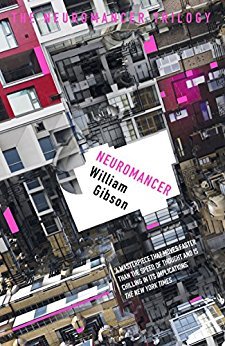
One of, if not the, granddaddy of cyberpunk, Neuromancer by William Gibson creates an incredibly vivid world if you can penetrate the difficult writing style.
As with all my reviews, I’ll be objective about the writing technicalities, and specify where I feel something is valid but not to my taste. My final rating will be an average of my objective score and my personal opinion.
I use the Goodreads star scale:
1 = did not like it
2 = it was ok
3 = liked it
4 = really liked it
5 = it was amazing
There are no spoilers in this review.
So what is it?
short_synopsis
A cyberpunk thriller in which a down and out hacker is blackmailed into being the cyber expert for a heist.
plot
It’s sometimes difficult to discern exactly what’s going on in this book due to the way it’s written (see Prose below).
The introduction is slow and detailed, and sets the tone for the rest of the story. The main character is in a bad way with his hacking abilities medically muted, and he’s looking for small jobs to scrape money.
A strange man comes into his life and gives him his abilities back, but also puts a time-limited poison in him. He’ll get the antidote if and when he completes his part in a heist.
The middle section of the book flits from place to place, introducing and discarding characters, locations and concepts. Cool ideas are scattergunned throughout, and many of them are interesting enough to warrant more attention than they get.
Things slow down as it focusses for the finale, and it becomes a little easier to follow. The threads are tied off with no real surprises – in fairness, that could be because this was widely copied.
people
Every character is a cool idea for a person, rather than feeling “real”. Differentiating between them can be tricky at times because there’s little to distinguish one from another except their appearance, which of course you don’t see all the time in a written medium.
The main character is a vessel for the plot, and it’s told in his first person perspective. There’s no greater goal, very little backstory, and his only aim seems to be to survive. As a result, both he and the story felt shallow.
place
The world is the undoubted star of this book and is the reason this is regarded as a touchstone in the history of cyberpunk.
Incessant description hammers home the aesthetic of this story world: it’s dark, neon-lit, tech-filled, corporation-controlled, and dangerous. Vivid and stylish, but hollow.
The individual locations are underdrawn and therefore difficult to picture, not helped by the sheer volume of them. The story hops from place to place a lot.
prose
The writing style is incredibly dense and detailed, overly so, to the point it can be difficult to read. Every noun needs at least one descriptive word before it, which does add a lot of colour to the world, but I often wished some of it had been removed to let sentences flow better. It was overkill, and it made the book one-paced and difficult to decipher at points. The plentiful jargon didn’t help either.
Being generous, the difficulty mirrors the overwhelming nature of this world, so the density puts us in the shoes of the main character. Whether that was intentional on the part of the author or not, I don’t know.
One trait I can’t be as generous about was the peculiar habit of the characters using each other’s names repeatedly in dialogue. It’s unnatural for anyone to use the other person’s name in multiple consecutive sentences in a single conversation.
Also, one character was given a particular pattern of speech that meant it was often tricky to understand what he was supposed to be saying.
conclusion
I’ve seen other reviewers write that this book benefits from multiple readings, and I can understand the writing may be easier to enjoy if you’re spending less time trying to work out what’s going on. But this review is based on my first readthrough only; if I read it again, I’ll update it.
It’s difficult to know how to rate this book. Many of the ideas are really good, and its influence is undoubted, but it was a chore to read – this was every bit as challenging as some of the “difficult” classics. The main value to reading it is to understand its historical significance.
Personally, I’d give it a two out of five. From an objective technical standpoint, I can’t give it more than a three because of the ill-defined characters and the onerous writing style.
I don’t give half-marks, so it gets…
My score: 2 out of 5
A list of the book reviews posted to my blog is here.

