
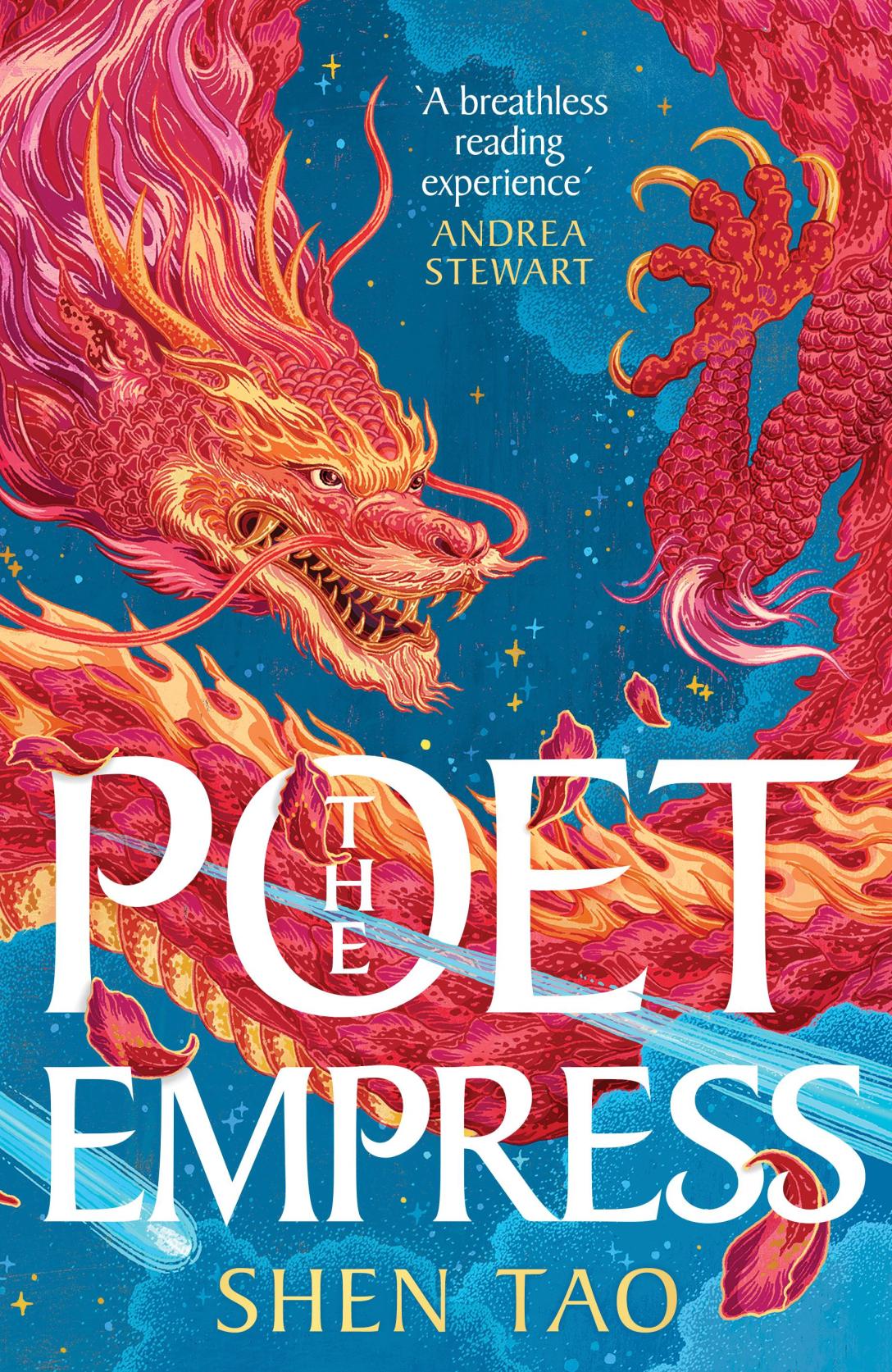
The Poet Empress by Shen Tao is beautiful and horrible and one of the best books I’ve read all year.
As with all my reviews, I’ll be objective about the writing technicalities, and specify where I feel something is valid but not to my taste. My final rating will be an average of my objective score and my personal opinion.
There are no spoilers in this review.
So what is it?
short_synopsis
In a magical world, a peasant offers herself as concubine to a cruel and invincible prince in an effort to save her starving village, and becomes the only person who can kill him.
plot
I’ve seen this categorised as romantasy. There’s no romance here; it’s far darker.
Wei is a poor rice farmer in a land that’s struggling through famine, so when she’s pitted against girls who’ve been groomed by noble clans to appeal to princes, it’s a test of her wits and resilience, and she must learn quickly. She is a true underdog, and the story effectively sets up the scale of her task and the result if she fails.
The powerful and invincible prince Terren, rebellious and drunk, selects Wei as concubine as a protest against the empress and his advisors, and sets about torturing her at every opportunity, bringing her to the brink of death only to save her and repeat it the next time. This isn’t sexual violence – there’s no sex here, no hint of romance between the two of them – but it is violent abuse and it is unpleasant to read.
Wei discovers there’ll be a very short window of opportunity to kill Terren during his ascent to the throne, when he must temporarily remove his invincibility to fight a dragon. Doing so would involve using literomancy, a form of magic performed by writing poems, to write a love poem to the man she hates. And women are forbidden from reading and writing.
She must learn to read and write, and she must get to know her torturer, without getting caught and murdered, whilst others scheme to take her down, and with the ticking clock of the current emperor’s failing health.
The stakes are always high, and there are numerous threats to Wei, not just from Terren. The multiple moving pieces are juggled well, with each close scrape leaving her vulnerable to someone else.
There is a slight sag in the second quarter as Wei reads Terren’s brother’s journals, trying to find backstory to understand him better. Much of it is fleshing out events we’ve already heard the basics about; a bit less information earlier on would have made this section less repetitive and more interesting.
We’re constantly being asked whether the ends justify the means, and whilst readers’ opinions will vary, I found it kept a good balance without ever making Wei fully unlikeable – even when she did things I didn’t like, I understood her reasoning and the difficult position she was in.
There are some very dark moments that I won’t spoil here. If you have concerns about any particular topics, the author includes trigger warnings before the first page, but they do include spoilers.
On at least a couple of occasions, I thought I knew where the story was going to end up, but I would never have predicted the twists and turns of the finale, nor several of the revelations along the way. None of the surprises felt like cheats, and actually felt inevitable in the best way.
The ending is satisfying and makes perfect sense, but I felt it missed one opportunity for reconciliation I’d like to have seen.
people
The story is told almost exclusively in the first person perspective of Wei, with the exception of chapters that are excerpts from Terren’s brother’s journals. Wei’s sympathetic and naive from the start, and is easy to support, but as she becomes more knowledgeable and adept at the political games of the palace, we’re asked how far we’re willing to back her.
Also central to the story is the relationship between Terren and his elder brother Maro, and how they went from being best friends to rivals.
The entire cast have individual combinations of motivations, beliefs, tactics, and limits. Every initially-nasty character has at least one redeeming trait, and every initially-good character has at least one failing.
place
Given the author’s Chinese background, it’s not a surprise this world feels like a China from the past with added magic and strange creatures.
There are two forms of magic. Each is interesting in its own way.
One is hereditary in the royal family: a seal on a prince’s cheek develops into a seemingly random power when they reach around ten years old.
The other is literomancy aka writing poems, which seemingly anyone can do if they have the training, but it’s only seen in the palace. Women are forbidden from reading or writing.
The divide between the rich and poor is vast. Coming from the rice fields makes Wei feel inadequate in her new surroundings, but is also a motivator, and it plays a part throughout. The story doesn’t forget about the tough lives of the populace once we get into the glamour of the palace, and that contrast is regularly used and used well.
prose
The beauty and viciousness of the world is sold by the writing, which is rich and evocative without ever getting bogged down in endless description, and moves along at a decent pace.
The style and word choice are perfectly suited to this setting. It will be interesting to see this author write something different, to see whether the writing was tailored to the story, or the story fit her natural style.
conclusion
Other than a small disappointment at a missed opportunity in the ending, and the slight sag in the second quarter, I felt there was one relatively minor logic gap, also in the second quarter, that I won’t specify as it’s a spoiler.
Those are the only “complaints” I have. Everything else about this book is fantastic.
I suspect it will reward repeat reads given late reveals about the characters apply a different perspective to earlier events.
The cover and title may make this sound like it will be a lovely tale, but it’s dark. That dichotomy makes it difficult to know who to recommend this to: fans of really dark fantasy may not appreciate the beauty; and anyone expecting a pretty story of poems may be shocked by some of the happenings. (In fact, there was a lot less poetry than I anticipated, only a few short passages). But anyone who likes emotional range in their fantasy novels will love this.
I don’t like making judgements about my all-time favourites too soon after my first experience, but as I write this, it’s up there. Don’t be surprised if this is near, or even at, the top of my 2026 rankings at the end of the year.
My score: 5 out of 5
A list of the book reviews posted to my blog is here.

