
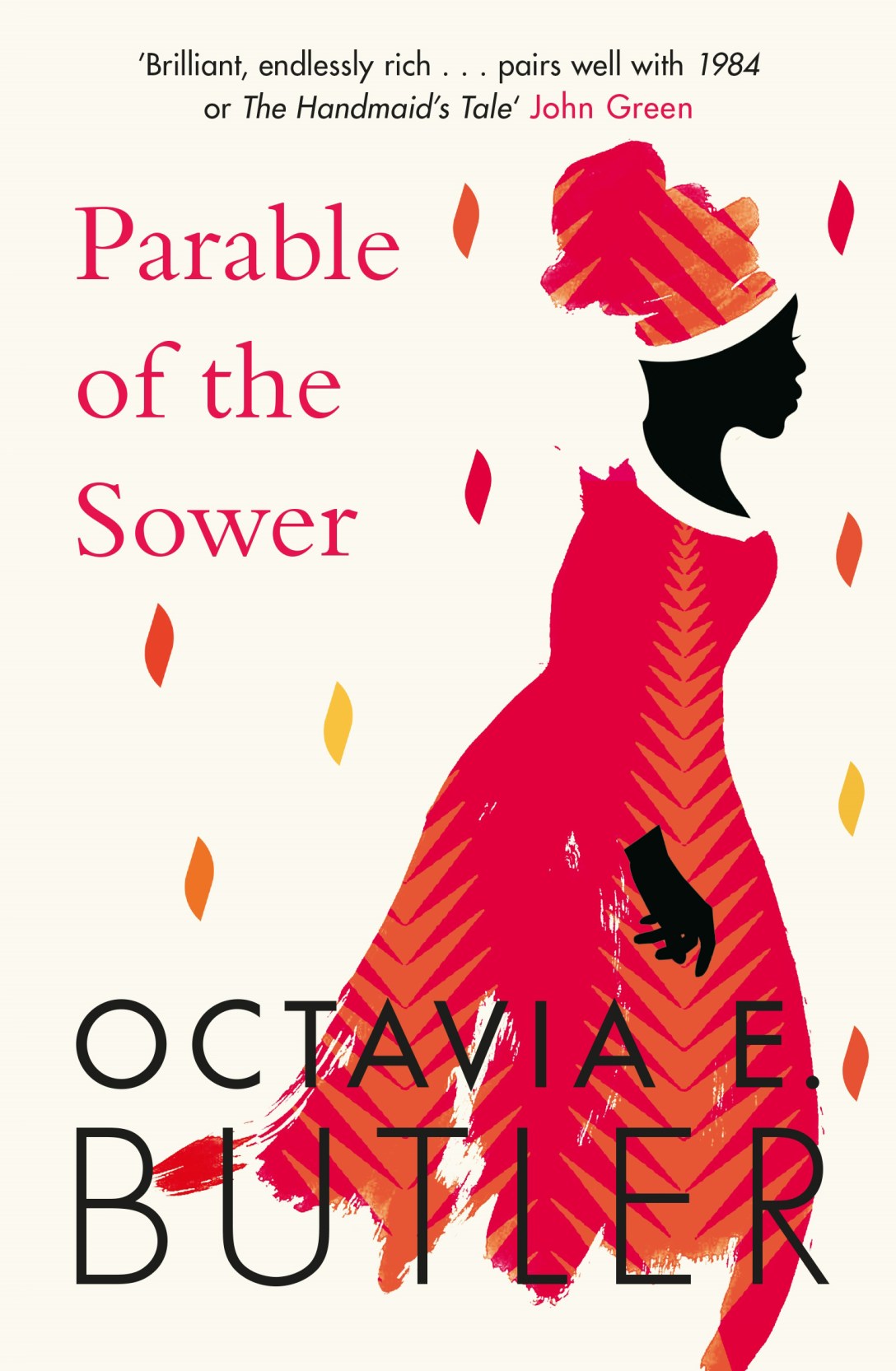
I liked many of the ideas in Parable of the Sower by Octavia E Butler, but the journal format hindered its impact.
As with all my reviews, I’ll be objective about the writing technicalities, and specify where I feel something is valid but not to my taste. My final rating will be an average of my objective score and my personal opinion.
There are no spoilers in this review.
So what is it?
short_synopsis
In a dystopian America, a teenage girl plans to leave her vulnerable sheltered existence to spread the word about her new religion, Earthseed.
plot
The story begins 20+ years after American society fell. Our main character, her family, and a few other families live in a small neighbourhood protected by high walls, with the occasional break-in by thieves and/or vandals, and the first half of the book is almost entirely stationary world-building. Events take place but nothing much changes beyond there being more regular warnings and some talk of preparing for the inevitable. I think the aim was to create tension, but it didn’t work, mostly because of the journal format (more on that under the prose section below).
The second half changes things up and we see a little more of the world. Still, the final aim is always vague, and it feels like a collection of textural short stories loosely tied together.
The finale was an anti-climax – the story just stopped. Perhaps the author always intended for this to be the first of two parts (there is a sequel, The Parable of the Talents), but I think it would have been better to shrink the first half of this and put both parts in one book.
Whilst a lack of empathy for others is the main throughline, the author takes aim at capitalism, racists, misogynists, sexual abuse, the police, politicians, drug use, slavery, the rich, paedophiles, and religion.
people
The main character is an intelligent teenage girl with an affliction called “hyper-empathy”, which leads her to feel what others around her feel, including injuries: if she shoots someone, she feels the pain as if she’s been shot too. It’s an intriguing idea, and thematically plays into her wish for other people to be more empathetic, but there are issues.
It isn’t applied consistently. It has an impact multiple times during the story, but mostly in the same way; there are so many different feelings and situations that could have been really interesting, so it felt like a missed opportunity.
As the story is told in the first person perspective of the main character, everyone else is seen through her lens. The hyper-empathy would allow her to feel how other characters are feeling, and tell us, but there’s precious little of that.
The other characters feel distant and aren’t well-rounded, and many of them are very similar, especially at the beginning where there are so many names, it’s difficult to keep track of who’s who.
place
The world is the villain.
Considering the book spends so much time world-building, it’s no surprise this is its strongest aspect. It feels hostile and horrific and hopeless, at least in their area. What hope there is comes from the main character’s desire to leave Earth and start again in the stars, which seems impossible (it’ll be fascinating to see how this is resolved in book 2).
It’s never explicitly explained what triggered the collapse of society, but the hints point to water scarcity due to climate change. It’s been bad for so long that the main character has no memory of “before times”, so it’s understandable there’s no explanation of how everything fell apart.
There isn’t much variety in the locations visited, or the people interacted with, which makes sense in that everything is supposed to feel broken and almost hopeless.
prose
The book is presented in the form of a journal, and it suffers from the typical drawbacks of the format: it removes all urgency and immediacy from scenes, and neutralises any tension, especially over whether the main character will survive – of course she does, she wouldn’t be writing this if she hadn’t.
It may have been a deliberate choice to create that distance from some of the horrible events that happen, because it could have been a difficult read, but I would rather have had that than this, which felt unemotional – odd for a journal written by someone with “hyper-empathy”.
The writing style is quite basic, and there’s very little colour or description, very few metaphors or similes. It’s functional and easy to read, almost as if the author aimed it at youngsters, but some of the actions perpetrated are too disturbing for an immature audience.
It could be argued the simplistic style makes sense if the journal’s written by a girl of fifteen (at the start of the story), and that she wouldn’t write elegant flowing prose about horrific events, and that’s fair. It is another drawback of the journal format though.
conclusion
It was a bit of a struggle to write this review because I didn’t have very strong feelings about this book. Despite all the horrific happenings, they were too removed: I could think how horrible they were, but not feel it. The journal format made it more of an intellectual exercise than an experience.
Some readers may prefer that, because it’s easier to think about some of these things than to feel them.
I’ve seen this put in a similar bracket to 1984 and The Handmaid’s Tale, but they had worlds that were unique and fresh. The world in this book is broken, but there’s no twist that makes it different from any other dystopia.
The main difference is in where the hope comes from: the new religion, Earthseed. I felt more could have been made of it; I expect much more in the sequel.
My opinion of Parable of the Sower may change once I’ve read Parable of the Talents, but for now, this gets a middling rating.
My score: 3 out of 5
A list of the book reviews posted to my blog is here.
 Arrowmaker Books