
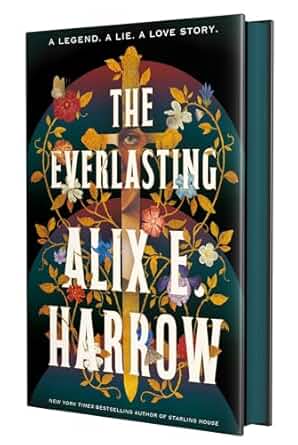
I don’t believe a flawless novel exists, but The Everlasting by Alix E Harrow doesn’t have a single glaring issue that I found. And I looked.
As with all my reviews, I’ll be objective about the writing technicalities, and specify where I feel something is valid but not to my taste. My final rating will be an average of my objective score and my personal opinion.
There are no spoilers in this review.
So what is it?
short_synopsis
A scholar is sent back in time to write the story of a legendary lady-knight who inspired a nation.
plot
There are plenty of reveals and surprises throughout which make it difficult to write about any story details without spoiling something. It feels intricately plotted but never confusing, and despite travelling back and forth through time, I never got lost.
I haven’t mapped everything out to decipher whether the causes and effects lined up over the different timelines, but there were no obvious discrepancies. The book is separated into different sections to help with clarity.
As a time-loop drama, we do cover the same ground more than once, but we don’t see every run through, and every run we do see is different enough that it doesn’t get boring or overly repetitive – only enough so we can determine what’s changed.
The pace ebbs and flows, and the story doesn’t stop moving even when the characters do. The pauses for breath are welcome and the relative lulls are never dull.
It has two main themes.
The first asks how far people are willing to go for what they want, whether it be love or power.
The second is about how history is written by the winners, and not always accurately.
The story also touches on nature vs nurture, abuse, corruption, racism, and honesty in journalism – it never lectures on any of them, and each add colour to the world (and parallels to our own).
The build-up to the finale ties up some loose ends enjoyably before the last section puts a satisfying full stop on the story.
people
The tale centres around a scholar and a knight. The male scholar is a self-confessed coward and is easily outmuscled by the lady-knight. The manosphere must hate this book.
Both are sympathetic characters – the scholar immediately so, the knight revealing themselves more gradually – and it’s enjoyable spending time in their company, whether they’re alone or together.
To nitpick, think the knight was harder to connect to as a character. This is mostly because the knight is more guarded and cautious of letting people close, and has more secrets, which keep us at a greater distance. We also spend barely any time with the knight when the scholar isn’t around, but we do spend time with the scholar without the knight.
Admittedly, I’m naturally more like the scholar, so that may be part of it too.
We wait a while before the villain is unveiled, and even longer before we find out how bad they really are (and why), but each escalation and reveal is well-placed. I felt the villain became a bit cartoony towards the end, despite the backstory’s efforts to humanise them, but as the writing didn’t take itself too seriously, I wasn’t put off (although I think it might have been more effective if the villain had been written a little straighter).
There are other characters that play minor roles, but this is very much a three-piece.
place
The author doesn’t give pages of detail about how everything works in this world, but we get enough to know what we need to.
In the more modern times where the scholar begins, there are deliberate similarities to our world in the past, with motorcars and cigarettes.
A thousand years earlier, in the time of the knight that the scholar travels back to, there’s one last dragon and small villages, but we don’t see much of what society was like back then. More could have been made of the scholar being a fish-out-of-water, but he is an historian, and it wouldn’t have added much to the story.
There’s a limited number of locations, and it’s interesting to see how they differ on each occasion we visit them as we travel through time.
prose
This book has an unusual structure, and alternates between second-person perspectives as the scholar and the knight tell the story to each other. It’s a difficult method to make work (and to be picky, I would ask why they’re describing the events to someone who experienced it), but it fits.
The writing style is wonderfully and efficiently descriptive, with many creative and amusing comparisons that were fresh and grew the world around the characters. There has to be exposition in a fantasy novel to explain the disparities to what we’re used to, but it never felt like a textbook.
The story didn’t hit me in the feels. This may be a personal reaction as I’ve seen other reviews describing their emotions after reading it, but for me, the strength of the main couple’s feelings weren’t wholly earned: the scholar seemed to be in love with the knight before he met her; and the knight gave no sign that the scholar was someone she’d be interested in until that changed quite quickly.
It may also be because there’s a sense of humour and a light touch that made it feel less serious and therefore less impactful to me.
conclusion
I vibed with the writing style of this immediately, and as I read on, it became clear every facet is top-tier. It’s creative and witty and unpredictable and beautifully written.
For what this book is trying to be, I struggle to find any criticism of it. It’s not one of my all-time favourites, but it will stick long in the memory.
It brings together a lot of common elements – time travel, fantasy, mystery, romance, a little political commentary – and weaves them together in a way I haven’t seen before. If you like any of these individually, I’d recommend reading this book. Even if any of these elements put you off, I’d still recommend you read it. It’s that good.
My score: 5 out of 5
A list of the book reviews posted to my blog is here.

