
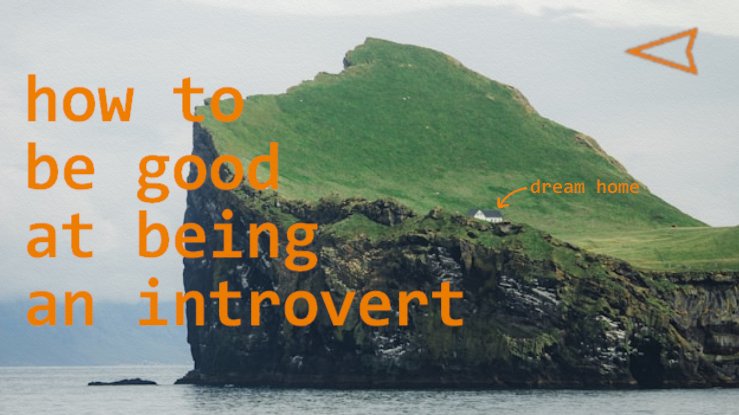
Blog season 2, episode 8: alone but not lonely
Introverts are not weird. Extroverts may think we’re quiet, shy, miserable, boring, or anti-social, but they don’t understand how draining it is to be around them.
There are plenty of things, big and small, that us introverts can do to make life less tiring and more fulfilling. But first, it’s important to understand what we need and don’t need, and why extroverts aren’t (always) evil.
introversion
Simply put, whereas extroverts get energy from being around other people, introverts get their energy from being alone.
This doesn’t necessarily mean introverts want to be alone all of the time, but we do need time away from others to recharge our social batteries.
Everyone is an individual.
How much alone-time we need will vary.
Some of us get lonely; some don’t.
Many of us can be shy, or come across that way because we’re not interested in the spotlight.
Most of us don’t like small talk, but revel in deep conversations about meaningful topics.
Large groups can be tiring or intimidating, so we generally prefer small get togethers or one-on-ones.
There are several facets of everyday life that challenge introverts, such as socialising, interacting with others, work, shopping, going places alone, and hobbies, so let’s look at each of them in turn.
socialising
It is a mischaracterisation to accuse introverts of being anti-social. It’s true that large or even medium-sized gatherings can be uncomfortable and exhausting, but we can be engaging company in small groups or one-on-one.
It’s not just the size of get-togethers that’s relevant – the frequency has an impact as well. Too many quiet meet-ups, too close to each other, can be just as draining as one big party.
The most crucial skill an introvert can learn is to understand when we need a break from people.
The second most crucial is how to reject invitations we don’t want to accept.
We must not lie or make up excuses. If we’re honest about our introversion, that’s often respected and people will be more understanding for future invites. If someone does not appreciate our needs and teases us, or gives us a hard time, we should ask ourselves whether that person is worth socialising with.
There can be peer pressure to attend, such as at work or school/college/university. These events are almost always not compulsory. If the coercion feels akin to bullying, a firm no is the only response, otherwise it will continue and repeat in the future.
We must not accept an invite then back out at the last minute or, worse, just not go.
We do need to be aware that if we say no constantly, or repeatedly fail to turn up, people will stop inviting us. Different people will have different tolerances; some may ask only once or twice.
Sometimes we need to go out when we don’t want to, to maintain a relationship we want to keep.
Calendar management and leaving sufficient rest gaps between social events is important for introverts.
Everyone will have some events that are non-negotiable. These can be fixed (like holidays, birthdays, etc) or be special one-offs (such as weddings). The bigger the one-off event, the more likely there will be a long notice period, which makes planning simpler.
Some intervals between gatherings will be longer than others, and these are the times it’s easier to fit in any other meet-ups we may want.
An effective way to manage a social calendar is to take control by arranging meet-ups on our terms. Obviously, the person we’re arranging to meet will need to agree, but if it becomes the norm (tacit or otherwise) that we always initiate contact, we have the opportunity to suggest times that are less strenuous to us.
If we organise a meet-up, we also get to decide who attends – and who doesn’t.
Every introvert has their own balance to find between loneliness and feeling drained by people.
attending social events and interacting with others
There are some things introverts can do to make attending social events less anxiety-inducing.
We can prepare conversation topics beforehand. If we already know everyone else who’ll be there, we can have certain subjects in mind that they’re interested in. For example, if we know a friend likes a certain musician who has a new album coming out, that’s a great conversation starter.
If there’ll be people at the event that we don’t know, we can prepare some general topics that must not be controversial, such as current movies, TV, sports, etc.
We do not need to be the life and soul of a party. In any group, some people will always talk more than others – that’s natural. It’s perfectly fine to join a group and mostly listen, perhaps interjecting an amusing comment or story if we have something relevant to say.
To avoid being on the receiving end of awkward questions, we can encourage others to talk about themselves, listen, and ask follow-ups. The more other people are talking, the less we need to talk, and the less chance of embarrassing ourselves.
If we do have an awkward interaction, we must not beat ourselves up.
Feeling ashamed at something we’ve said or done shows a valuable level of self-awareness. Everyone embarrasses themselves at some time or another (unless they’re a narcissist). We should learn any lessons there are to learn and move on. Sure, the memory will still cause us to cringe twenty years later, but dwelling on it isn’t helpful.
No-one gets along with everyone. If we don’t click with someone, that doesn’t mean we’re at fault.
Choosing when to leave a social event can be awkward and depend on numerous factors, too many to cover here.
To give us the maximum flexibility and control, we can travel to events by ourselves. If we’re not dependant on anyone else for a lift, nor are tied to giving someone else a ride home, we can make an exit when we’re ready.
work
As an introvert, there are some jobs that fill me with dread. Salesperson. Lecturer. Receptionist. Tour guide. Any kind of supervisor. Anything in customer service.
The dream (other than not needing to work at all) is to be self-employed without having to deal with any customers or agents or anyone. Until some genius discovers a way to legally earn money without someone buying something from us, we’ll have to make do with roles like the following examples that minimise interaction with others:
- Programmer
- Writer
- Editor
- Artist
- Researcher
- Freelancer
For introverts, working in an office is far from ideal. The Covid lockdowns demonstrated we could work from home (and be much happier), so being forced back to the office, even for reduced days, can be frustrating – particularly if it’s easier to concentrate and get more done without the noise and distractions and interruptions of an office environment.
One solution is noise-cancelling headphones, which can be really effective at muting chatter and background noise. I can personally vouch for the Sony WH-1000XM4 cans, which are a few years old and difficult to find now, but I understand each new generation (the 5s and 6s) improves the noise-cancelling further.
We must keep in mind some managers frown on the use of headphones, even if they don’t explicitly say so, as it can come across as anti-team.
On the subject of teams, team-building events can feel like corporations trying to “cure” introverts. The worst of them aim to get everyone to embarrass themselves as a way of bonding, which is excruciating for those who already feel awkward all the time. It’s perfectly reasonable to explain any discomfort and refuse to participate in that section of the event.
shopping
Shops are designed to grab attention to sell stuff, and when they’re packed with shoppers too, can be overwhelming.
Fortunately for introverts, we can now do virtually all our shopping online, and the only person we need to interact with is the delivery driver.
But there are occasions where it’s easier or necessary to visit an actual real-life shop. The most obvious tactic is to go when they’re likely to be less busy, such as during school- and office-hours, if possible.
Some stores have dedicated quiet times. My local supermarket, for example, has “quieter hours” with dimmed lights, no music, and no PA announcements. These are often at slightly awkward hours which can be difficult to attend, but that also means they should be less crowded. They are usually listed on the store’s website.
A pushy salesperson is the introvert equivalent of a T-1000 in Terminator 2.
If they interrupt to ask if we need help, the standard “I’m just browsing thanks” usually gets us some breathing room. If they persist, a curt “If I need anything, I’ll come find you” usually works.
going places solo
Some people don’t like going out by themselves because they feel ashamed, but there is no reason to be embarrassed. Very few people care, and really what difference does it make if they do?
The opinion of people we don’t know and will never see again is irrelevant.
We can begin with something we feel relatively comfortable with and build up to the ones we’re unsure about. To feel less awkward, we can take something to do with us, like a book or journal, knitting, headphones, etc.
All of the below activities are perfectly reasonable to do solo:
- Go to a café or restaurant
- Go to the cinema
- Go to a park
- Walking/hiking
- Exercise/go to a gym
- Fishing
Once we’ve got used to going places by ourselves, there’s no reason we can’t broaden it to taking holidays solo. Personally, I like going to a quiet lodge in the countryside, but there’s no reason not to go further afield or abroad.
If there are any concerns about safety, there are plenty of tours, which may also be an opportunity to meet other like-minded people.
hobbies
There are plenty of hobbies for introverts to do alone, either at home or getting out and about. Also there are lots of activities for those of us who like meeting in smaller groups to share a passion.
For the following, almost all can be done either solo or with a limited number of others:
- Gardening
- Arts and crafts (writing, drawing, painting, knitting, pottery, etc)
- Playing a musical instrument
- Reading (I can recommend my book, and I’ve reviewed a fair few)
- Playing video games
- Fishing
- Cycling
- Wargaming/role-playing (with friends, in a club, or some games can be played solo)
- Hiking
- Join a club (eg reading group)
you can leave now
One of the most common questions I get as an introvert is “Don’t you get lonely?”. The answer is no, I don’t. Not ever. This doesn’t mean I don’t like spending time with people (from time to time), but I prefer being by myself.
If you don’t get lonely, there’s nothing wrong with you.
If you do get lonely, it doesn’t mean you’re not an introvert.
If there are any other topics you’d like me to cover, or any tips you’d like to share with your fellow introverts, please leave a comment.
Featured image background photo by Robert Arnar on Unsplash
 Arrowmaker Books