
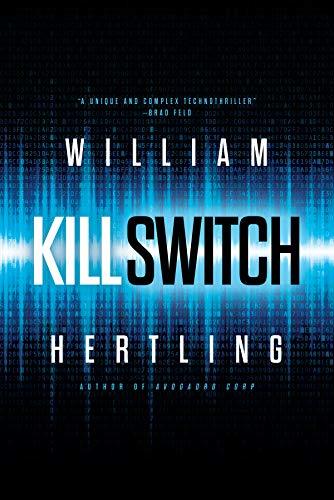
Technothriller Kill Switch by William Hertling is an interesting sequel that keeps the same formula but changes the ingredients, to lesser effect.
As with all my reviews, I’ll be objective about the writing technicalities, and specify where I feel something is valid but not to my taste. My final rating will be an average of my objective score and my personal opinion.
There are no spoilers in this review.
So what is it?
short_synopsis
A social media company races to make it impossible for the government to access their customers’ data before they are stopped permanently.
plot
This is the second and last book of this series, and whilst there are of course similarities to the first in terms of tone and subject matter, there are some brave deviations.
We have a different main character, Igloo, and her relationship with her girlfriend is an important part of the story, particularly their predilection for kink and exploration of a polyamorous relationship.
Themes of abuse of power run throughout and connect the two parts of the narrative effectively.
The main storyline revolves around the idea of online privacy and preventing government access to personal data. The prequel was the setup of a new social media platform that couldn’t share their customers’ data; in this book, the company has grown to such an extent that the government orders them to open a backdoor to their system for “national security” purposes.
Instead, the team race against time to create a version 2 that will make a backdoor and spying impossible.
The first half builds slowly, focussing as much on Igloo’s relationship as it does on the programming. It was interesting rather than exciting.
The story kicks into gear when it enters the second half. The stakes are raised, and the team is put in increasingly perilous positions, but it was predictable. There was a mole (there’s always a mole) and their identity was obvious long before they were unmasked; and none of the reveals were at all surprising.
There were some nice ideas, and some interesting discussions about national security versus personal privacy, but it ended exactly as I expected it to.
people
Angie, the main character from book one of the series, is relegated to a much smaller part here.
Instead, Igloo, one of Angie’s colleagues from the company she founded, is the lead. I found her slightly less interesting but likeable. Her partner was a bit dull, as were many of the side characters who filled roles for the plot instead of feeling like real people.
The main villain is a little OTT but his motives are well displayed and understandable, even if his actions become irrational for someone who attained the position he’s in.
place
The area the story was based in, Portland, didn’t play much of a part. Most of our time is spent hiding in shadowy locations or running.
There was more about the wider America and the threat of an unnamed dangerous new president (surely Trump). The threat was mostly from government agencies, which exacerbated the sense that danger was all around.
It was suggested more than once that they leave the country, which would have solved most of their problems, and the excuses given to stay felt weak.
prose
I would describe the writing style as functional and detailed, which suits the story being told. There isn’t much in the way of beautiful description, but plenty about the technicalities of how things work and why they work that way.
I consider myself quite techy without being an expert in coding, and I didn’t understand much of the IT jargon used. Often, context clues gave me enough of an idea what was going on, but I can imagine someone with little or no computer network experience could get confused.
There was also jargon used in the BDSM scenes (e.g. the types of ropes and knots used), but even with my lack of prior knowledge, it was clear who was doing what to whom.
There was an unusual spike of editing errors within a few chapters at around the 60% mark, plus a couple more near the end: several occurrences of words being duplicated, or in an order that doesn’t make sense (the kind of mistakes that wouldn’t be picked up by a spell-check but should be picked up by an editor). There is a note from the author that the second edition “trimmed the relationship plotline by 20%”, so perhaps these mistakes are remnants from changes that didn’t go through the same editing process as the rest of the book.
conclusion
I did quite enjoy reading Kill Switch but, for a thriller, there was a distinct lack of suspense. I was always confident how the story would end, and the attempted twists and turns never diverted me from that, which resulted in a lack of tension.
I gave book one in the series 4 out of 5. The consensus online appears to be that this book isn’t quite as good, a lot of people disliking the kink aspect; I didn’t mind that, and think the bigger issue was the lack of thrills for a technothriller.
I wouldn’t recommend reading this as a standalone – it would definitely make more sense to read book one first, and I do recommend that – and if you liked the prequel, you may like this too.
My score: 3 out of 5
A list of the book reviews posted to my blog is here.

