
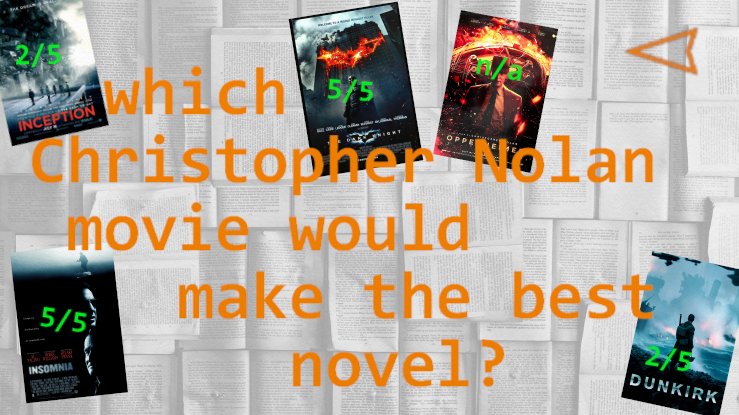
Blog season 2, episode 9: Nolan novelisations
The Odyssey is the second Sir Christopher Nolan film to be based on a novel, after The Prestige, but which, if any, of his complex, time-twisting stories would work well as written fiction?
I don’t mean whether one could be reshaped and remoulded – no, it needs to remain as faithful as possible to the source material, with maybe some added background and interiority. The structure, such an important element of his films, must remain.
Some will lose out more than others by the removal of spectacular visuals, acting, and music (eg Interstellar), but that doesn’t necessarily rule them out, as we’ll see.
In true Nolan style, I’m going to analyse them in reverse order of their release date.
SPOILER WARNING! There will be spoilers beyond this point.
Oppenheimer (2023)
Novelisation potential: n/a
Already, we have a difficult question: can a biopic, based on a non-fiction book of true events, be turned into a fiction novel? Whilst there will undoubtedly be fictional elements to the film, turning it back into a book would result in a biography, not a novel.
Instead of novelising the film, it makes more sense to read the book the film was inspired by, American Prometheus by Kai Bird and Martin J Sherwin.
Tenet (2020)
Novelisation potential: 1 out of 5
A film in which time travels backwards as well as forwards. The mind boggles trying to work out how you could effectively write the characters experiencing time backwards, but this more than most of Nolan’s movies was about the spectacular action.
Cars uncrashing, and a backwards person fighting a forwards person, will lose their impact in the amount of words it would take to adequately describe what’s happening. This is very much a visual story and a novelisation wouldn’t do it justice.
Dunkirk (2017)
Novelisation potential: 2 out of 5
On the face of it, this isn’t too difficult to adapt, and there have been plenty of war novels. But I’m willing to bet none of them used Nolan’s time trickery to have three strands play out concurrently despite covering different periods of time: the mole = 1 week; the sea = 1 day; the air = 1 hour.
In the film, he uses visual clues to link the three parts and help us see how they fit together. In a book, it would be clunky at best, confusing at worst.
Interstellar (2014)
Novelisation potential: 4 out of 5
There is an official novelisation of this movie which I haven’t read. It does have good reviews, and I can understand how it could work well. The finale with the tesseract could be tricky with its visual callbacks to earlier scenes, and of course no writing can put across the sense of scale that a shot of a tiny spacecraft flying in front of a planet can. You also miss out on Hans Zimmer’s score that’s in turns beautifully delicate and thunderingly powerful.
But the reason people have kept returning to this film, and it keeps finding new fans, is the family story at its core, and on a page that could be equally as impactful, if not more so.
The Dark Knight Rises (2012)
Novelisation potential: 5 out of 5
Batman of course began in comics, but this piece is investigating how the films would work as wordy novels, not graphic novels.
In the pantheon of Nolan movies, this is a relatively straightforward story without any time gymnastics to confuse potential readers. A novel would have more time to show us how people coped during the citywide lockdown: a chapter or two with the policemen underground could be interesting, for example.
The finale with the bomb being flown out over the bay would be delicate to write, but arguably the editing in the movie didn’t nail that either.
Inception (2010)
Novelisation potential: 2 out of 5
Story-wise, this could absolutely work well as a novel. Like Interstellar, it’s built around a man trying to get home to his kids.
The issue is that there are so many moments of visual storytelling: the city folding up over itself; the “kick” they use to wake up; the gravity anomalies when fighting in the rotating corridor; the paradox of the Penrose steps; the regular shots of the van falling slowly towards the water that work as a countdown for that dream level; and of course the spinning top.
This would be a tough one.
The Dark Knight (2008)
Novelisation potential: 5 out of 5
I’m tempted to dock a point purely because a book would omit Heath Ledger’s stunning performance as Joker, but this could make a fantastic novel. It’s an epic crime story more than a superhero caper, and the depth that was already on screen could be expanded on the page.
I’d probably add some interiority with Harvey so we can experience his fall, but keep out of Joker’s mind as the unknown is part of what makes him so unpredictable and menacing. Spending time with the people on the ferries trying to decide whether to blow up the other boat could also be really interesting.
The Prestige (2006)
Novelisation potential: 2 out of 5
The Prestige was based on an award-winning novel, told through the diaries of two magicians. For the movie, the diaries remained, but the story was changed substantially, so converting Nolan’s version back to a novel isn’t straightforward.
The magic tricks are visual so they’d lose some impact in a novel. The main twist would be tricky to handle (Christian Bale’s performance makes it work) and it would necessarily involve keeping us at arms length from one (two?) of the main characters, so it’s unlikely to have the same impact on the page as in the film.
Batman Begins (2005)
Novelisation potential: 4 out of 5
The success (or not) of a novelisation of this film would likely depend on whether Scarecrow can be made scary enough without the images of the fear gas’s impact. As with some of the other movies, some of the action sequences (Batman’s first appearance, the Batmobile chase, the fear gas taking hold in the Narrows) would suffer without the visuals too.
But the story is strong enough that this could be an entertaining read, especially if we take the opportunity to dive into Bruce Wayne’s psyche as he’s becoming Batman.
Insomnia (2002)
Novelisation potential: 5 out of 5
A Los Angeles detective chases a murder suspect in a remote Alaskan town.
The least complex Nolan movie, this would be relatively straightforward to adapt into a novel. There’s a lot of potential for expanding on the mental state of Al Pacino’s character (Detective Dormer) and his struggles to cope with a chronic lack of sleep, and on Hilary Duff’s Burr and her investigation into the shooting of Dormer’s partner.
It’s an underrated film. It could be at least as good, if not better, as a book.
Memento (2000)
Novelisation potential: 1 out of 5
This is right up there with Tenet for being virtually impossible to novelise, but for story rather than action reasons. The backwards time structure that’s signposted by a repeated few seconds after each jump could be replicated with repeated paragraphs, but wouldn’t work so well.
The black and white sequence that runs counter to the main storyline would be more difficult to signpost (although a different font might work), and is more likely to add confusion rather than clarity.
The initial mystery that works well on the screen is more likely to cause readers to give up.
Following (1998)
Novelisation potential: 5 out of 5
A young writer who follows strangers for material meets a thief who takes him under his wing.
Nolan’s first movie was shot independently on a shoe-string so is deliberately lo-fi, with no flashy or time-bending action set-pieces. It is told out of order but that could easily be replicated on the page.
Additional insight into our main character, Bill, has the potential to be fascinating, and the further we get into his mind, the more effective the final reveal would be. This has real potential.
and the winner is…
I’ve given four films a maximum 5 out of 5 rating, and two of them feature Batman:
- The Dark Knight Rises
- The Dark Knight
- Insomnia
- Following
But we set out to find the best, so which is it?
I think both Insomnia and Following would be introspective and literary, and if I have to pick between the two of them, I’d go for Insomnia. It’s a bit broader in scope, the setting of Alaska would be a strong character in itself, and it could be a tense thriller.
The Dark Knight always just beats out The Dark Knight Rises for me. Joker is more magnetic as a villain than Bane, and his antics are more entertaining. Bane executes his plan flawlessly then waits as Batman recuperates in a prison, whereas in The Dark Knight, there are more twists and turns and schemes that keep the story moving.
So, we’re down to the final two: Insomnia or The Dark Knight?
Neither is a bad choice. I think Insomnia would be easier to write well, but if you find the right writer who can match the tone of the movie, The Dark Knight has the potential to be epic.
Therefore my answer has to be The Dark Knight.
Do you agree? If not, which Nolan movie would you most want to read a novelisation of and why? I’d love to read your opinions in the comments.
Featured image background photo by Patrick Tomasso on Unsplash

