
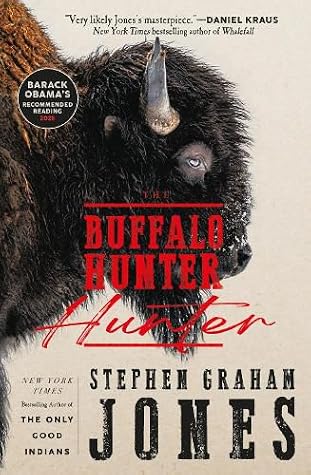
The strong concept of The Buffalo Hunter Hunter by Stephen Graham Jones was helped, but mostly hindered, by the style of writing.
As with all my reviews, I’ll be objective about the writing technicalities, and specify where I feel something is valid but not to my taste. My final rating will be an average of my objective score and my personal opinion.
There are no spoilers in this review.
So what is it?
short_synopsis
A historical horror in which a pastor hears the confession of an Indian-turned-vampire.
plot
Although the word “vampire” isn’t used until the penultimate sentence of the book, this is very much a vampire story.
We begin in 2012, with the an academic, the great-great-great-granddaughter of a pastor, being told her relative’s journal has been discovered; then we read the journal as written in 1912.
The pastor begins to receive a visit after his Sunday sermon every week, from an Indian who wants to confess.
Now, I began this book blind, expecting a based-on-real-events historical fiction. I was not expecting a vampire, so it took me a little while to realise what was happening, and the writing style didn’t help there either (see “prose” below).
There was an interesting twist on the nature of a vampire that I haven’t seen before, and won’t spoil, that played out in interesting ways.
The mid-section of the book was interesting and quite enjoyable, but much of it was superfluous to where it ended up. It could have been far shorter; this story is more about the journey than the destination.
At the end, we see the impact of this journal on 2012. The reaction felt unrealistic to me, and as we spent virtually no time with the academic great-great-great-granddaughter, and with a gap of some 350 pages, it was difficult to care about the situation she finds herself in. I recognised it was supposed to be tense, even scary, but I felt none of that.
There’s a theme of knowing who you are, and either hiding from that or trying to maintain it, that’s really interesting here.
people
This book is a little odd in that it begins and ends with a “main” character that we don’t see anything of for 350 pages in the middle of a 430-page book. The academic is little more than a sketch, and not a particularly likeable one, that I felt it difficult to care about come the finale.
The pastor was a man with a secret guilt (an easily-guessable secret) who was trying to hide from it, but there wasn’t much else to him.
Ironically, the most believable character of them all was the vampire, and his struggles to remain who he had been before he turned were set up and put across really well.
There are plenty of side characters, some in groups, but none hang around for long, and it’s sometimes difficult to differentiate between them all.
place
We don’t spend much time in the modern day, and there isn’t much to say about it.
However, the historical fiction parts were rich with description and I did get a real sense of when and where we were (generally if not specifically, because I was often unsure how the locations related to each other).
The choice to use Indian words for places, groups, animals etc was often confusing (see “prose” below), but added a sense of the unknown to the creatures and surroundings that made it feel less hospitable. The weather, the landscape, and the people were all regular threats, sometimes individually, sometimes combined, and the world felt dangerous even to a near-invincible vampire.
prose
As mentioned above, the story’s written as if we’re reading a journal, but from three different perspectives. There are logic gaps in the way it’s done. One example: the pastor says he writes the vampire’s confession “hours” after, but it’s written in the first person perspective of the vampire, conversationally, that would be impossible unless it was being dictated.
Some people may be able to look past such discrepancies, or not notice them, but they took me out of the story.
The biggest issues were in the style of writing.
The passages “written” by the pastor were very different in their use of language from the parts “written” by his great-great-great-granddaughter, and effectively so, but I found it difficult to get into the rhythm of them. They were very dense, and there was a strange mix of casual and formal at times.
There were gaps between the vampire’s chapters, filled with the pastor’s activities, and when we returned, it was often without any call-back or reference to where we’d left off. This can be fine if you’re reading in a couple of sittings, but if you read some every day over the course of a couple of weeks, as I did, you may need to turn back to remind yourself of what was happening.
The vampire uses Indian words regularly which adds credibility and colour that I, in part, appreciated. But I felt the context clues and descriptions were often insufficient to allow confident determination for people not used to that world. I reached the end still unsure what some of the terms he used were referring to.
There’s a lot of violence, and most of it was over-the-top and gross, but I didn’t mind it. It’s supposed to be shocking and it makes sense for the story.
conclusion
I really liked the concept, the theme, and the world of this story. The characters, other than the vampire, were a little weak, but not enough to spoil anything.
The writing style makes this a chore to read, and that prevents me from recommending this to anyone, which is a shame.
My score: 3 out of 5
A list of the book reviews posted to my blog is here.

